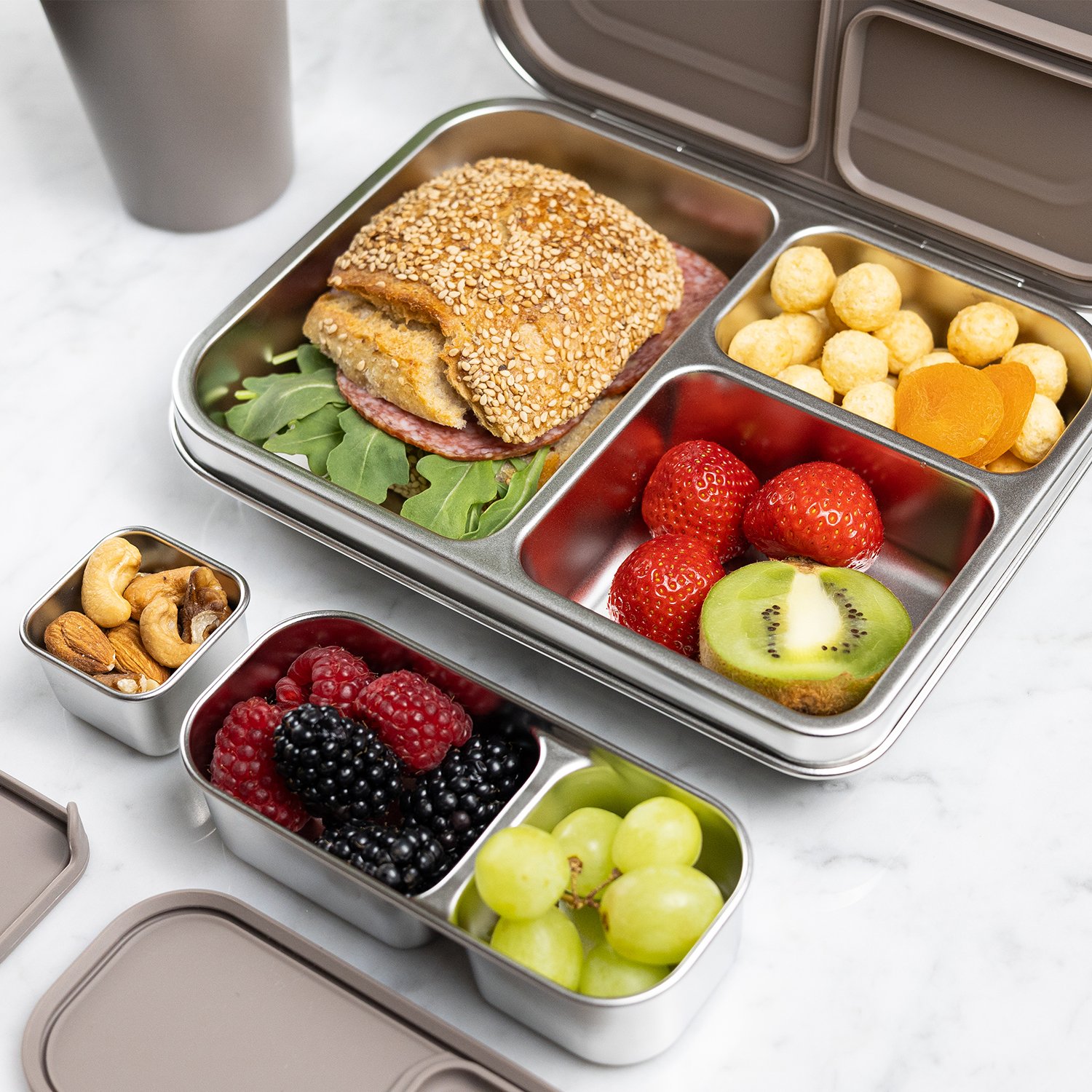
The best lunch box for children is one that suits the child's appetite, the length of the day, and the way the food is packed. For some children, a simple lunch box with one large compartment is the most practical solution. Others benefit more from a lunch box with 3 or 5 separate compartments, where different parts of the packed lunch can be kept apart.
Size is important, but capacity alone does not determine whether a lunch box works well. For children, you should also consider its weight, external dimensions, compartment layout, leakproof performance, and how easy it is to open and close.
As a general starting point, a lunch box with a capacity of around 800–1,000 ml will suit many nursery and school children, but needs vary considerably. A child with a short day and one meal has different needs from a schoolchild who needs a morning snack, lunch, and additional snacks.
In this guide, we therefore look beyond how big a lunch box for children should be. We cover the entire decision-making process, from nursery and starting school to the differences between 3 and 5 compartments, Bento lunch boxes, stainless steel lunch boxes, and separate snack boxes.
Which lunch box is best for children?
In short, the best lunch box for a child is large enough for their usual amount of food, but no larger or heavier than necessary. It should be easy for the child to open independently and have a compartment layout that suits the types of food they usually bring.
For many children, the choice typically comes down to three different options:
| Type | Best suited to |
| Lunch box with one large compartment | Larger open sandwiches, regular sandwiches, wraps, and simple packed lunches |
| Lunch box with 3 compartments | A main meal combined with fruit, vegetables, or a snack |
| Bento lunch box with 5 compartments | Lots of different smaller items and snacks |
There is no single solution that is best for every child.
A child who typically brings two large open sandwiches on rye bread and a piece of fruit may benefit more from one large main compartment than from five small sections. Another child may eat better when fruit, vegetables, bread, and small snacks are clearly separated.
That is why your child's usual packed lunch is a better starting point than their age alone.
How big should a lunch box for children be?
A capacity of approximately 800–1,000 ml is a good starting point for many children, but the right size depends on how much food the child needs and how the space inside the lunch box is divided.
Two lunch boxes can both hold approximately one litre and still feel very different to use.
A 1,000 ml lunch box with one large compartment allows you to use the entire space freely. A lunch box of roughly the same size with five fixed compartments distributes the space between several smaller sections. The total capacity may therefore be almost identical, while the practical uses are very different.
This is particularly relevant for children because larger foods such as open sandwiches on rye bread, regular sandwiches, and wraps require a relatively large, uninterrupted space. Berries, nuts, vegetable sticks, and small snacks need much less room and fit well into smaller compartments.
A practical starting point for capacity
| Capacity | Typical use |
| Approx. 500–600 ml | A small packed lunch, snack, or shorter day |
| Approx. 800–900 ml | An everyday packed lunch for many children |
| Approx. 900–1,000 ml | A varied packed lunch with several components |
| Over 1,000 ml | A larger appetite, long days, or several meals |
These figures should be used as general guidelines, not as strict age limits.
A nursery child may easily need more space than an older schoolchild if the nursery requires parents to pack all the day's food from home. Conversely, a large lunch box may be unnecessary if the child only needs lunch.
It is therefore better to ask:
How much food does the child usually bring?
Rather than:
How old is the child?
Lunch boxes for nursery – what should you choose?
A good lunch box for nursery should primarily be easy for the child to understand and use, simple to open, and suited to the meals they need throughout the day.
Everyday routines can differ considerably from one nursery to another. In some places, children only need to bring lunch from home. In others, parents need to pack a morning snack, lunch, and possibly an afternoon snack as well.
This has a direct impact on which lunch box works best.
If all the day's food needs to fit into the same lunch box, several fixed compartments can be practical. They allow you to organise different foods without using multiple bags or small containers.
If the nursery instead has separate eating breaks, with the child only needing to take out one smaller portion at a time, combining a regular lunch box with a separate snack box may be easier to manage.
Be careful not to choose a lunch box that is too large.
It can be tempting to choose a large lunch box so there will always be plenty of room. However, for younger children, the overall size and weight should also be considered. A very large lunch box takes up more space in a backpack, and lunch boxes with numerous features, sturdy locking mechanisms, and multiple materials typically weigh more than a simple container.
This does not mean that a heavier lunch box is necessarily a poor choice. However, its weight should be a conscious decision rather than a surprise.
Lunch boxes for school – what requirements change?
When a child starts school, their lunch box is typically transported to and from school almost every day. Size, weight, durability, and ease of use therefore become particularly important.
A school lunch box needs to fit into the rest of the child's daily routine. The school bag may also need room for books, a computer or tablet, a pencil case, a water bottle, and PE clothes. The physically largest lunch box is therefore not necessarily the most practical, even if it has the most attractive compartment layout.
At the same time, the school day is often longer than a day at nursery, and some children need more food. Choosing a lunch box is therefore a balancing act between sufficient capacity and a practical size. For schoolchildren, both a flexible lunch box of around 850 ml and models of approximately 900–1,000 ml with fixed compartments may be suitable. Once again, the deciding factor is how the food is packed.
A child who mainly brings open sandwiches on rye bread and a snack may benefit from one larger section. A child who brings lots of different small items may get more out of a Bento lunch box with several compartments.
Read also: Lunch Box for Starting School – How to Choose the Right One.
Lunch boxes with compartments for children – are they necessary?
A lunch box with compartments is not necessary for every child, but it can be very practical when different types of food need to be kept apart. Compartments primarily solve an organisational problem. Fruit can release juice. Vegetables can contain moisture. Crispy snacks can become soft if they are stored with moist foods. Some children also simply prefer their different foods not to touch each other.
Fixed compartments can make the packed lunch easier to organise and understand. However, more compartments also mean less flexibility. If a child needs to bring a large sandwich or an entire wrap one day, fixed dividers may limit the available space. The number of compartments should therefore be chosen according to the types of food you pack most often, rather than assuming that more compartments are always better.
Should you choose 3 or 5 compartments for children?
Three compartments are best suited to a traditional packed lunch with one larger main meal and a couple of smaller items. Five compartments are better suited to a packed lunch consisting of many small portions.
That is the fundamental difference.
Lunch box with 3 compartments
SteelMate's 3-compartment lunch box has a total capacity of 1,000 ml, divided into 500 ml + 300 ml + 200 ml.
The largest compartment therefore accounts for half of the lunch box's total capacity. This provides relatively generous space for foods such as open sandwiches on rye bread, regular sandwiches, pasta, or a smaller main dish. The other two compartments can be used for fruit, vegetables, or snacks.
This layout is particularly suitable when the packed lunch has a clearly defined main component.
Bento lunch box with 5 compartments
SteelMate's Bento lunch box has a total capacity of 935 ml, divided between five compartments: 340 ml + 215 ml + 182 ml + 131 ml + 67 ml.
Here, the available capacity is distributed more evenly. The largest compartment is smaller than the one in the 3-compartment model, but the child gets four additional compartments in different sizes. The 5-compartment model is therefore particularly useful when the packed lunch often consists of several smaller items.
Comparing 3 and 5 compartments
| 3 compartments | 5 compartments | |
| Total capacity | 1,000 ml | 935 ml |
| Largest compartment | 500 ml | 340 ml |
| Number of smaller compartments | 2 | 4 |
| Best suited to | A larger main meal | Lots of small items |
| Empty weight | 500 g | 670 g |
The important point is that 5 compartments do not mean greater capacity.
In fact, SteelMate's 3-compartment model has a slightly larger total capacity. The main difference is how the available space is distributed.
It is therefore more accurate to think of it this way:
3 compartments = more space around the main meal
And:
5 compartments = a more detailed division of the packed lunch
Rather than viewing the 5-compartment model as a larger or more advanced version of the 3-compartment model.
Read more in our guide to lunch boxes with compartments.
What is a Bento lunch box for children?
A Bento lunch box is a lunch box with several separate sections, inspired by the Japanese tradition of bringing different parts of a meal together in one divided container. In modern usage, the term often refers to lunch boxes with several fixed compartments.
The main advantage for children is that different types of food can be packed together in one lunch box without the need for numerous separate containers. For example, a Bento lunch box can hold a main meal in the largest compartment and smaller portions in the others. However, this does not mean that a Bento lunch box is suitable only for certain types of food or that a packed lunch needs to look a particular way.
Bento primarily describes how the lunch box is divided. For children who prefer variety and smaller portions, this layout can be practical. For larger sandwiches or other foods that require plenty of continuous space, a lunch box with fewer compartments may be more flexible.
Read also: Bento Lunch Box – What Is It, and Which One Should You Choose?
Can children open a stainless steel lunch box themselves?
They should be able to if the lunch box is intended to be used without help from an adult. The opening and closing mechanism should therefore always be considered when choosing a lunch box for children.
SteelMate's 3-compartment children's lunch box uses clips designed to be opened by children, but finger strength and motor skills vary. It is therefore still a good idea to let your child try using the lunch box at home before taking it to nursery or school.
This matters not only the first time the lunch box is used.
A child should be able to:
- Open the lunch box, close it correctly again, and understand how the locking mechanism works.
- Recognise that a leakproof lunch box may lose its sealing performance if it is not closed correctly.
For younger children, ease of use is therefore just as important as capacity and the number of compartments.
How big can a lunch box be and still fit in a school bag?
The external dimensions are just as important as the lunch box's capacity. A tall, narrow lunch box and a low, wide lunch box can hold almost the same amount of food but fit very differently inside a bag.
For example, SteelMate's 1,000 ml 3-compartment model measures 23.5 × 18 × 4.7 cm, while the 935 ml Bento model measures 25.5 × 18.5 × 5 cm. For comparison, a more traditional SteelMate lunch box with a capacity of 850 ml measures 17.8 × 12.2 × 6.3 cm. It is considerably shorter and narrower, but taller. This means you cannot determine which model takes up the least space in a bag based on capacity alone.
If your child already has a particular school bag, it is a good idea to check the lunch box's external dimensions before buying it. This is especially relevant for low, wide Bento models.
Should a lunch box for children be leakproof?
It is a clear advantage if you regularly pack moist foods, very juicy fruit, dressing, or similar items. However, with lunch boxes that have compartments, it is important to distinguish between two different types of sealing. A lunch box can be sealed around its outer edge to prevent liquid from leaking into the school bag without necessarily keeping the individual compartments sealed from one another.
For children, sealing between compartments can be useful because a single juicy food item might otherwise affect the rest of the packed lunch. SteelMate's 3- and 5-compartment children's lunch boxes use a moulded platinum-cure silicone insert on the underside of the lid. When the lunch box is closed, the insert seals around the individual compartments. The design is therefore intended both to prevent leaks to the outside and to keep the contents of the individual compartments separate. This works differently from a removable divider.
On SteelMate's 850 ml model, the stainless steel divider can be moved or removed, providing considerable flexibility. However, the divider itself does not create a separate liquid-tight seal. The lid's silicone gasket provides the seal against the outside environment.
The difference can be summarised as follows:
- Fixed, individually sealed compartments: designed to keep moisture separated between compartments as well.
- Removable divider: designed to organise food, but not to create separate liquid-tight containers.
- This distinction is important if you are specifically looking for a leakproof lunch box with compartments for children.
Stainless steel lunch boxes for children – what are the advantages?
A stainless steel lunch box is particularly interesting for children because the material combines mechanical durability, a smooth surface, and long-term usability. SteelMate's lunch boxes are made from 304 stainless steel, also known as 18/8 stainless steel.
Stainless steel is a non-porous material. This means that the steel surface itself does not absorb food in the same way that more porous materials can. Stainless steel also handles normal everyday use well and can develop scratches and minor signs of wear without necessarily losing its functionality. It is worth distinguishing between cosmetic marks and actual damage. A scratch on the outside does not, by itself, mean that the lunch box can no longer be used. With everyday transport in a school bag, some signs of wear are to be expected over time.
Another practical property is that stainless steel does not require a coloured or printed inner surface to function as a food container.
There are, however, some limitations. Metal must not be used in a conventional microwave oven. If your child's food needs to be heated in a microwave, it must first be transferred to a suitable container.
Read also: Stainless Steel Lunch Boxes – A Guide to Materials, Use, and Selection.
18/8 and 304 stainless steel – what do they mean?
304 refers to a very commonly used grade of stainless steel. The designation 18/8 refers to the alloy's approximate content of 18% chromium and 8% nickel. Among other things, chromium helps make the steel resistant to corrosion by contributing to the formation of a very thin protective oxide layer on the surface.
SteelMate's stainless steel lunch boxes are made from 304 (18/8) stainless steel.
However, when a lunch box is used for food, the grade of steel is not the only relevant consideration. The finished product must also be suitable for its intended food-contact use. Documentation relating to the finished product should therefore carry more weight than general claims about material types alone.
Is silicone necessary in a stainless steel lunch box?
Not all stainless steel lunch boxes contain silicone, but the material is often used for gaskets or seals because steel against steel does not, by itself, create a flexible, leakproof closure. SteelMate's 3- and 5-compartment models have a stainless steel food container and a removable platinum-cure silicone insert in the lid.
The silicone therefore serves a different function from the steel. The steel forms the rigid container, while the softer silicone insert can create a close seal around the edges and individual compartments. It is therefore not necessarily meaningful to assess a lunch box based on whether it is made from a single material.
A design that uses different materials for different functions can be more practical than a solution in which the entire product must be made from the same material.
One lunch box or a lunch box plus a snack box?
A large lunch box is the simplest solution, while a separate snack box offers greater flexibility throughout the day. For children, the choice primarily depends on how the nursery or school organises eating breaks. If the entire packed lunch is eaten at once, one lunch box is often easiest.
If the child has, for example, a short morning break followed by a longer lunch break, a small snack box can be useful. It can be taken out without opening the entire lunch box. A snack box can also be used for foods that you want to keep completely separate. This may be an advantage even when the main lunch box already has compartments.
The relevant question is therefore not necessarily:
- "How many compartments should the lunch box have?"
But rather:
- "How should the child's food be divided throughout the day?"
These are two different questions.
We cover ideas for what to pack in a lunch box in our separate packed-lunch inspiration section.
Read also: Snack Boxes – A Guide to Snacks and Small Meals.
Should siblings have the same lunch box?
Not necessarily. Buying the same model for several children can be practical, but siblings may have very different needs. One child might prefer large sandwiches and only a few different items. Another may eat small portions of many different foods.
There may also be differences in:
- Appetite, the length of the school day, age, transport to school, and how much the child needs to carry themselves.
- For these reasons, two different lunch boxes may be the most functional solution, even if the children attend the same nursery or school.
- The lunch box should be chosen for the person using it, not solely for the family as a whole.
How long can a lunch box for children be used?
This depends on the material, the construction, and how the child's needs change over time. A very childish design may be rejected long before the lunch box itself wears out. A neutral design can, in principle, stay with the child through several age groups, provided the size remains suitable. A stainless steel lunch box may develop scratches, small dents, and other signs of wear after many trips in a school bag. These are not necessarily reasons to replace it.
What matters instead is checking the functional parts.
Does the lunch box still close properly? Is the seal intact? Is the locking mechanism in good condition? Are there any sharp deformations or other actual damage? Functionality and food safety should determine when a lunch box needs replacing, rather than whether the outside still looks brand new.
How do you clean a lunch box for children?
A lunch box should be cleaned after use and allowed to dry properly before it is closed and stored. Lunch boxes with removable gaskets or silicone inserts should be taken apart periodically so that the edges and joints can also be cleaned. SteelMate's 3- and 5-compartment models can be disassembled, and both the stainless steel container and the silicone insert are dishwasher-safe, following the manufacturer's instructions. Even if a lunch box is washed in the dishwasher, it is good practice to remove the gaskets and inserts regularly and check the areas underneath them.
After washing, all parts should be allowed to dry completely. Storing a lunch box with a damp, closed lid is generally less suitable than leaving it open until all the parts are dry.
Read also: How to Clean and Maintain a Stainless Steel Lunch Box.
How to choose a lunch box for your child
If you want to make the decision as simple as possible, start with four questions.
1. How much food does your child need to bring?
This determines the capacity required.
2. What does your child's usual packed lunch look like?
One larger main meal points towards fewer, larger compartments. Lots of small items point towards more compartments.
3. How are eating breaks organised?
Several separate breaks may make a combination of a lunch box and a snack box practical.
4. Can your child handle the lunch box independently?
Check its size, weight, and opening and closing mechanisms.
Once these four questions have been answered, the number of suitable lunch boxes becomes much smaller. Only then does it make sense to choose between different designs and colours.
Which SteelMate lunch box suits which need?
SteelMate's range for children can broadly be divided according to how you want to use the available space.
| Need | Suitable option |
| A lightweight, compact lunch box | 550 ml |
| A flexible lunch box for an older child | 850 ml with a removable divider |
| One larger main meal plus side items | 1,000 ml with 3 fixed compartments |
| Lots of different small items | 935 ml Bento with 5 fixed compartments |
| Snacks alongside the main meal | A separate snack box |
Age alone does not determine the right choice. For example, an 850 ml model may be the best solution for an older schoolchild who prefers one large sandwich, while a 5-compartment model may be better for a younger or older child who eats lots of smaller items.
SteelMate's 3-compartment model is particularly suitable if you need plenty of room for a substantial main meal.
SteelMate's 5-compartment Bento model is particularly suitable if variety and clear organisation matter more than having one large, uninterrupted compartment.
That is the functional difference between the models.
Frequently asked questions about lunch boxes for children
How big should a lunch box be for nursery?
There is no single correct size, but around 800–1,000 ml can be a useful starting point if your child needs to bring a full packed lunch. If the child only needs one small meal, a smaller lunch box may be sufficient. The most important factors are the nursery's meal arrangements and your child's appetite.
How big should a lunch box be for school?
Many schoolchildren can use a lunch box of around 800–1,000 ml, but long school days may require more food or an additional snack box. Also check the lunch box's external dimensions to make sure it fits in the school bag alongside the child's other belongings.
Is a lunch box with 3 or 5 compartments better?
Three compartments are often best if the packed lunch consists of one large main meal and a few smaller items. Five compartments are often best if the child brings lots of different small foods. The number of compartments should therefore be chosen according to the layout of the packed lunch.
What is a Bento lunch box?
A Bento lunch box is a divided lunch box inspired by the Japanese Bento tradition. In modern use, the term typically refers to a lunch box with several fixed compartments that allow different parts of a meal to be kept separate.
Should a lunch box for children be leakproof between compartments?
It is not essential for every type of food, but it is an advantage if you pack juicy fruit, dressing, or other moist foods. Be aware that a lunch box can be leakproof on the outside without being liquid-tight between the individual compartments.
Is stainless steel good for children's lunch boxes?
Stainless steel is suitable for lunch boxes because it is durable, has a smooth, non-porous surface, and can be reused over a long period. However, for children, the material should be considered alongside the finished lunch box's weight, construction, and ease of use.
Can a stainless steel lunch box go in the microwave?
No. Lunch boxes and other metal containers must not be used in a conventional microwave oven. If the food needs to be heated, it must first be transferred to a microwave-safe container.
Is a heavy lunch box bad for children?
Not necessarily. However, the empty weight of the lunch box should be considered alongside the food and the rest of the contents of the child's bag. Weight may be more important for a child who carries their school bag over long distances every day than for a child who only transports their lunch box a short distance.
Conclusion: The best lunch box for children depends on everyday needs
There is no single lunch box that is best for every child. The right lunch box needs to suit three things at the same time: the child, the food, and the daily routine surrounding meals. For a traditional packed lunch with one larger main meal, a lunch box with 3 compartments is often a practical solution. For children who bring lots of different small items, a Bento lunch box with 5 compartments provides a more detailed layout. For older children or simpler packed lunches, a lighter lunch box with one large compartment or a removable divider may be a better choice.
For many children, a capacity of around 800–1,000 ml is a good starting point, but capacity should never be considered on its own. The lunch box's weight, dimensions, compartment layout, leakproof performance, and opening mechanism are just as important. The best choice is therefore not necessarily the lunch box with the most compartments or the largest capacity. It is the lunch box your child can use easily every day.