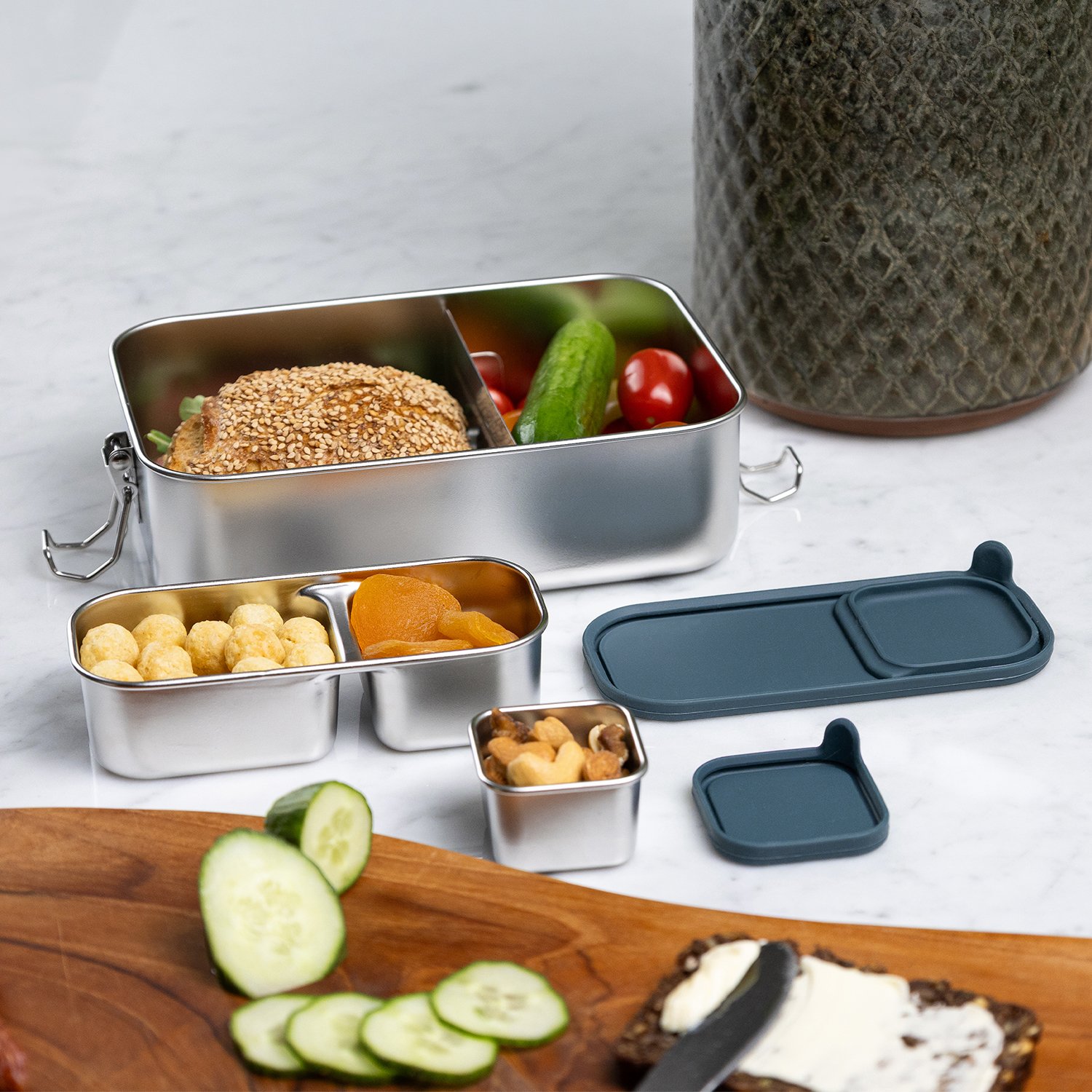
A good lunch box should first and foremost suit the person who will use it. There is a big difference between the right lunch box for a child in nursery, a schoolchild with a long day ahead, an adult at work, or someone who wants to bring a large salad or several meals from home.
That is why there is no single size or type of lunch box that is best for everyone.
When choosing a lunch box, there are five main things worth considering: size, compartments, leakproofness, material, and who will be using it.
In this guide, we cover all five to help you determine whether you need a small lunch box of around 550 ml, a standard lunch box of around 850–1,000 ml, a large lunch box of 1,400 ml, or a lunch box with fixed compartments.
Which lunch box should I choose?
In short:
- For snacks and a small packed lunch: around 500–600 ml.
- For an everyday lunch: around 800–1,000 ml.
- For a large adult lunch or meal prep: around 1,200–1,400 ml or more.
- For children who bring lots of different small items: a lunch box with 3 or 5 fixed compartments.
- For changing meal requirements: a lunch box with a removable divider offers the greatest flexibility.
- For salad dressing, juicy fruit and similar foods: check both whether the lunch box is leakproof on the outside and whether the individual compartments are sealed against each other.
The most important thing is not to find the largest lunch box or the one with the most compartments. It is about finding a size and layout that suit the way the food is actually packed and eaten.
Quick guide to choosing a lunch box
| Need | A good size or type to start with |
|---|---|
| Snacks, fruit or a couple of sandwiches | Approx. 550 ml |
| Everyday lunch | Approx. 850 ml |
| Flexible packed lunch | Lunch box with a removable divider |
| Lunch box for children | Approx. 900–1,000 ml with fixed compartments |
| Many small items in a packed lunch | Bento lunch box with 5 compartments |
| Classic children's packed lunch | Lunch box with 3 compartments |
| Large adult lunch | Approx. 1,400 ml |
| Meal prep or a long day | Large lunch box with flexible compartments |
The sizes are guidelines. How much space you need naturally depends on appetite, age and the type of food you normally pack.
5 things to consider before choosing a lunch box
The most important questions to ask yourself are:
- How much food needs to fit inside?
- Should the food be separated into compartments?
- Does the lunch box need to hold moist or liquid foods?
- How large and heavy can it be?
- Does a child need to be able to open and close it independently?
These questions may sound simple, but it is often the combination of these factors that determines whether a lunch box works well in everyday life.
For example, a large lunch box with five compartments may be practical for a varied packed lunch, but unnecessary if you mainly take a sandwich to work. Conversely, a small lunch box without compartments may work perfectly for some children, while others benefit from keeping fruit, bread and snacks separate.
Start with your needs rather than the lunch box itself.
What size lunch box should I choose?
As a general rule of thumb:
- 500–600 ml: a small lunch box or snack container.
- 800–1,000 ml: an everyday lunch.
- 900–1,000 ml with several compartments: a varied packed lunch for a child.
- 1,200–1,400 ml: a large lunch, a bigger appetite or meal prep.
Capacity tells you how much a lunch box can hold, but millilitres do not tell the whole story.
For example, a 1,000 ml lunch box with three separate compartments works differently from a lunch box of roughly the same size with one large compartment. The shape of the food also matters: rye bread sandwiches, sandwiches and wraps often need a larger continuous area, while berries, vegetables, nuts and smaller snacks are easier to distribute between smaller compartments.
Comparing lunch box sizes
SteelMate's current range of lunch boxes illustrates the differences well:
| Size | Compartments | Typical use |
|---|---|---|
| 550 ml | 1 compartment | Snacks, a couple of sandwiches or a small lunch |
| 850 ml | 1 or 2 sections with a removable divider | Standard school or work lunch |
| 935 ml | 5 fixed compartments | Bento-style packed lunch for children |
| 1,000 ml | 3 fixed compartments | Classic, varied packed lunch for children |
| 1,400 ml | 1 or 2 sections with a removable divider | Large lunches, long days and meal prep |
SteelMate's 550 ml model measures 16 × 10.4 × 6 cm and weighs 170 grams, while the 850 ml model weighs 260 grams. The large 1,400 ml model weighs 370 grams. The fixed-compartment models for children are larger: the 3-compartment model holds a total of 1,000 ml and weighs 500 grams, while the 5-compartment Bento model holds 935 ml and weighs 670 grams.
This also shows why capacity and weight should be considered together.
A lunch box may have the right capacity but still be larger or heavier than you would like to carry in your bag every day.
Read also: Which lunch box size should I choose?
Should you choose a lunch box with or without compartments?
In short:
- One large compartment: the most flexible space for larger food items.
- Removable divider: a good combination of flexibility and separation.
- 3 fixed compartments: suitable for a main meal plus two smaller items.
- 5 fixed compartments: suitable for lots of different small items.
The number of compartments is not just about how the packed lunch looks. The layout also affects which types of food you can pack and how flexible the lunch box is from one day to the next.
Lunch box without compartments
A lunch box with one large compartment is the simplest solution.
It works well for, among other things:
- Open-faced rye bread sandwiches
- Sandwiches
- Wraps
- Salads
- Pasta dishes
- Leftovers from dinner
- Fruit or snacks
The advantage is that the entire volume of the lunch box can be used freely. You are not restricted by fixed dividers.
On the other hand, fruit, dressing, snacks and other small items may need to be packed in separate snack containers if you do not want the food to mix.
Lunch box with a removable divider
This is a good option if you want compartments on some days and one large space on others.
A removable divider sits somewhere between a traditional lunch box and a bento box with fixed compartments.
For example, you can position the divider to create:
- One large section for a sandwich and a smaller one for vegetables
- Two more evenly sized sections for two different dishes
- One large compartment if you remove the divider entirely
SteelMate's 850 ml and 1,400 ml lunch boxes use this solution. The divider can be moved or removed completely.
This makes this type particularly useful for adults and older children whose packed lunches vary considerably from day to day.
There is, however, an important difference between a divider and a liquid-tight compartment. A removable divider can keep solid and semi-solid foods practically separated, but it is not necessarily a sealed barrier against thin dressing or sauce.
We will return to this distinction further down.
Lunch box with 3 compartments
Three compartments work well when a packed lunch consists of one main meal and two smaller items.
A classic layout might include:
- Rye bread sandwiches, a sandwich, pasta or a wrap in the main compartment
- Fruit in one smaller compartment
- Vegetables or a snack in the other
SteelMate's 3-compartment lunch box for children holds a total of 1,000 ml, divided into compartments of 500 ml, 300 ml and 200 ml.
The large main compartment still provides room for a proper meal, while the two smaller compartments make it easy to keep side items separate. This makes three compartments a good balance for many classic Danish packed lunches.
Bento lunch box with 5 compartments
Five compartments are particularly useful if a packed lunch consists of lots of different smaller items.
For example, you can have separate compartments for:
- Sandwiches or a smaller main dish
- Fruit
- Vegetables
- Nuts
- Berries
- Cheese
- A small snack
SteelMate's Bento lunch box holds 935 ml, divided into five compartments of 340, 215, 182, 131 and 67 ml respectively.
In practice, this means that five compartments do not necessarily provide space for more food than three compartments. Above all, they provide more options for separating different items.
If your child mainly eats large rye bread sandwiches or regular sandwiches, three compartments may therefore be more practical. If the packed lunch consists of lots of smaller items, five compartments may be an advantage.
Read also: Lunch boxes with compartments – should you choose 1, 3, 5 or a removable divider?
3 or 5 compartments – which is best?
Choose 3 compartments if:
- You need plenty of room for a larger main meal.
- The packed lunch usually consists of 2–3 types of food.
- Your child eats rye bread sandwiches, sandwiches, wraps or larger portions.
- You want a simple layout.
Choose 5 compartments if:
- The packed lunch consists of lots of smaller items.
- You often pack fruit, vegetables, berries and snacks separately.
- Your child prefers several different small portions.
- You want a clearly divided, bento-inspired layout.
There is no particular number of compartments that is generally best for children.
The best choice depends on how the child eats.
A child who prefers two large rye bread sandwiches and a little fruit has different needs from a child who prefers small portions of five different things.
Lunch boxes for children – what should you look for?
When choosing a lunch box for a child, pay particular attention to:
- Whether the child can open the lunch box independently
- The empty weight of the lunch box
- Whether it fits inside the child's bag
- Whether it has enough room for the amount of food the child normally eats
- Whether fixed compartments suit the way the packed lunch is prepared
- How effectively the compartments keep different foods separate
It is easy to focus on the layout when choosing a lunch box for a child. However, ease of use is just as important.
If the child needs to eat independently at nursery or school, the lunch box must be easy to open without difficulty. It can therefore be a good idea to let the child practise opening and closing it at home first.
Weight is also worth considering. Schoolchildren in particular often carry a water bottle, books, a computer, sports clothes and other items in their bags.
And remember the external dimensions.
A lunch box can have the perfect compartment layout without necessarily fitting well inside the school bag you are using.
Read our complete guide to lunch boxes for children.
Which lunch box is suitable for nursery?
The short answer: Choose a model the child can handle and that has enough space without being unnecessarily large.
The needs of a nursery-aged child vary depending on the nursery. Some children only need one meal, while others also need a morning snack or an afternoon snack.
Fixed compartments can be practical here because the food for the entire day can be organised in one box. However, a separate snack box can be just as practical if different meals are eaten at different times.
The most important thing is therefore not necessarily to have as many compartments as possible, but to choose a solution that suits the routines of both the nursery and the child.
Which lunch box is suitable for school?
Four things are particularly relevant when choosing a school lunch box: size, weight, opening mechanism and compartment layout.
Once children start school, their lunch box becomes a regular part of their school bag almost every day.
A school lunch box should therefore ideally:
- Withstand being carried around every day
- Be easy for the child to open independently
- Fit properly inside the school bag
- Have enough room for food for the entire school day
- Be easy to clean again in the afternoon
Some schoolchildren prefer a larger lunch. Others need a morning snack, lunch and smaller snacks throughout the day.
A lunch box with compartments or a combination of a lunch box and a snack container can make it easier to organise the day's food.
Read also: Lunch boxes for the start of school – how to choose the right one.
Lunch boxes for work – how large should they be?
A good starting point is:
- 550 ml: a small lunch or snack.
- 850 ml: an everyday work lunch.
- 1,400 ml: a large lunch, meal prep or a long working day.
Adults often have different needs from children when it comes to lunch boxes. An adult typically has less need for lots of small fixed compartments but may benefit from greater flexibility. For example, if you bring a sandwich on Monday, pasta salad on Tuesday and leftovers from dinner on Wednesday, a lunch box with one large compartment or a removable divider will often be practical.
For an everyday lunch, around 850 ml is a sensible place to start. If you have a large appetite, work long days or bring several meals from home, a larger lunch box of around 1,400 ml gives you more room.
Read our complete guide to lunch boxes for work.
What does it mean for a lunch box to be leakproof?
Important: There is a difference between:
- Whether the lunch box is sealed against leaks on the outside
- Whether the individual compartments are sealed against each other
This is an important detail to consider when comparing lunch boxes.
A lunch box can have a tightly fitting lid that prevents the contents from escaping into your bag without the internal divider necessarily preventing liquid from moving from one section to another.
Leakproof on the outside
In this case, the outer lid seals tightly around the lunch box itself.
This is relevant if you pack items such as:
- Juicy fruit
- Salad with dressing
- Hummus
- Moist leftovers
- Other foods containing liquid
Sealed compartments
If you want to keep liquids completely separate inside the lunch box, each individual compartment also needs to have a tight seal around it.
SteelMate's 3- and 5-compartment models have a removable platinum-cure silicone insert in the lid that seals around each compartment. On models with a removable stainless steel divider, the outer box is leakproof, but the loose divider does not create a completely liquid-tight barrier between the compartments.
This means, for example, that vegetables and a sandwich can easily be separated using a divider, while very runny dressing is better stored in a small separate container.
Read also: Leakproof lunch boxes – what does it actually mean?
Which material should you choose for a lunch box?
The most common materials are:
- Stainless steel
- Plastic
- Glass
- Silicone
- Combinations of several materials
Each material has its own strengths.
Plastic can be very lightweight. Glass is suitable for many types of food storage but is heavier and can break. Silicone can be flexible and is often used for lids, seals or collapsible solutions.
Stainless steel combines relatively low weight with high mechanical durability, making it suitable for products that are transported back and forth every day.
There is, however, one important limitation:
A stainless steel lunch box must not be used in a microwave oven.
If you need to heat your lunch in a microwave, you must first transfer the food to a suitable plate or container.
Materials and articles marketed for food contact in the EU are covered by regulations on food contact materials. Under normal and reasonably foreseeable conditions of use, they must be manufactured so that they do not transfer constituents to food in quantities that could endanger human health or cause an unacceptable change in the food's composition, taste or smell.
Read also: Stainless steel or plastic – which material should you choose for your lunch box?
What are 304 stainless steel and 18/8 steel?
In short, 304 and 18/8 are often used to describe the same type of stainless steel for kitchen products.
The designation 18/8 refers to the approximate content of the alloy:
- 18% chromium
- 8% nickel
Chromium plays an important role in the steel's corrosion resistance, while nickel contributes to the alloy's properties and stability.
SteelMate's lunch boxes and stainless steel containers are made from 304 (18/8) stainless steel.
Stainless steel is not plastic. BPA and phthalates are therefore not constituents of the steel itself.
When comparing lunch boxes, however, it is always more important to consider the finished product's documentation for food contact than to focus on a single material designation alone.
Read our in-depth guide to stainless steel lunch boxes.
Is a stainless steel lunch box heavy?
Not necessarily, but the construction makes a significant difference.
A simple stainless steel lunch box can be relatively light, while a large lunch box with fixed compartments, a locking mechanism and silicone seals will naturally weigh more.
For example, SteelMate's lunch boxes weigh:
- 550 ml lunch box: 170 g
- 850 ml lunch box: 260 g
- 1,400 ml lunch box: 370 g
- 3-compartment lunch box for children: 500 g
- 5-compartment Bento lunch box: 670 g
That is why it does not make sense to ask only:
“Is steel heavy?”
The more relevant question is:
“How much does this particular lunch box weigh in relation to its size and function?”
For a small child, the difference between 260 and 670 grams can be noticeable. For an adult travelling by car or carrying lunch in a work bag, the difference may be less important.
Should you choose one large lunch box or several small containers?
A large lunch box is best when:
- You want fewer separate items to keep track of.
- You eat your entire lunch at the same time.
- You bring larger dishes with you.
Several containers are practical when:
- You eat snacks at different times.
- Dressing needs to be kept completely separate.
- You want to vary portion sizes.
- You need to pack several different meals.
It does not have to be an either-or decision.
A large lunch box combined with a small snack container is a very flexible solution.
For example, you can use the main lunch box for sandwiches, rye bread sandwiches or salad, and the smaller container for dressing, nuts, berries or an afternoon snack.
Read also our guide to snack boxes and small food containers.
Bento lunch box – what does bento mean?
A bento lunch box is typically characterised by several separate compartments that allow different parts of a meal to be packed individually. The term originates from the Japanese bento tradition, in which a meal is packed together in a container, often with several different components. In modern lunch boxes, the term is often used for models with several fixed compartments. This makes the bento layout particularly suitable for packed lunches containing lots of different small items. However, a bento lunch box is not automatically better than a lunch box with fewer compartments.
If you bring a large sandwich, salad or leftovers from dinner, one large continuous compartment may be considerably more useful. Read our complete guide to bento lunch boxes.
How do you clean a stainless steel lunch box?
After normal use:
- Remove food residue.
- Wash the lunch box according to the manufacturer's instructions.
- Clean seals and removable components.
- Allow all parts to dry properly.
- Only reassemble the lunch box once it is dry.
- Lunch boxes with silicone seals or inserts should be designed so that they can be taken apart, allowing you to clean around the seal as well.
On SteelMate's 3- and 5-compartment models, for example, the silicone insert can be removed, and both the lunch box and the insert are dishwasher-safe according to the product instructions.
It is a good idea to check the manufacturer's specific cleaning instructions, as the construction can vary from one model to another.
Read also: How to clean and maintain a stainless steel lunch box.
How to find the right lunch box in 4 steps
1. Start with the amount of food
Ask yourself: How much do I or my child actually eat?
Then choose an approximate capacity range.
A very large lunch box does not necessarily provide more flexibility if it is only half-filled every day and takes up unnecessary space in your bag. Conversely, a lunch box that is too small can quickly become frustrating if you have to pack snacks separately every day.
2. Choose compartments according to the type of food
Ask yourself: Does the packed lunch consist of one large dish or lots of small items?
- One large dish → one compartment
- Changing contents → removable divider
- Main meal plus side items → 3 compartments
- Lots of small items → 5 compartments
This is a better approach than simply choosing the model with the most features.
3. Consider how leakproof the lunch box needs to be
Ask yourself: Will you only pack dry food, or will you also bring dressing, very juicy fruit or similar items?
Check both:
- Sealing against leaks into your bag
- Sealing between the individual compartments
These two things are not necessarily the same.
4. Check the weight, dimensions and opening mechanism
Especially for lunch boxes intended for children, check:
- External dimensions
- Empty weight
- Opening and closing mechanism
- Whether the lunch box fits inside the bag
Only when all four steps work together have you really found the right lunch box.
Comparison: which SteelMate lunch box is right for whom?
| Model | Capacity | Compartments | Best suited for |
|---|---|---|---|
| Small stainless steel lunch box | 550 ml | 1 | Snacks, small meals and light lunches |
| Stainless steel lunch box with removable divider | 850 ml | 1–2 | Everyday lunches, school and work |
| Bento lunch box | 935 ml | 5 | Children and varied packed lunches |
| Lunch box for children | 1,000 ml | 3 | Nursery and school |
| Large stainless steel lunch box with divider | 1,400 ml | 1–2 | Adults, large lunches and meal prep |
This does not mean that a particular model can only be used by the target group listed.
For example, an 850 ml lunch box can easily be used by both children and adults. The table simply shows which needs the different sizes and layouts are typically best suited to.
Frequently asked questions about choosing a lunch box
How large should a lunch box be for a child?
Around 800–1,000 ml is a relevant starting point for many children's packed lunches, but age and appetite matter more than the number itself.
A younger child with one short eating break may need considerably less, while a schoolchild with a long day may need both lunch and snacks. Consider the amount of food, the external dimensions of the lunch box and its weight.
Is 850 ml enough for a packed lunch?
For many people, 850 ml is a good size for an everyday lunch. It will typically accommodate rye bread sandwiches or a regular sandwich combined with some fruit or vegetables. For large salads, meal prep or several meals, 1,400 ml may be more practical.
Is 1,400 ml a large lunch box?
Yes. At 1,400 ml, a lunch box is at the larger end of the usual range for lunch containers. This size is particularly useful for large portions, meal prep, picnics or people who need to bring food for a long day.
Should children have a lunch box with compartments?
Not necessarily. Compartments are useful if your child brings different types of food that should ideally be kept separate. If your child mainly eats sandwiches or rye bread sandwiches with a little fruit, a simple lunch box combined with a snack container can work just as well.
Are 3 or 5 compartments better for children?
Three compartments are typically best for a larger main meal with two types of side items, while five compartments work well for lots of smaller items. The choice should therefore depend on the child's usual packed lunch rather than age alone.
What is the difference between a removable divider and fixed compartments?
A divider can normally be moved or removed, while fixed compartments are part of the lunch box's construction. Removable dividers provide greater flexibility. Fixed compartments, on the other hand, offer a more consistent layout.
Can you put dressing directly into a lunch box with compartments?
It depends on the construction. Even if the lunch box is leakproof against your bag, this does not necessarily mean that the compartments are liquid-tight against each other. If you regularly bring liquid dressing, choose a model with sealed individual compartments or use a small separate container.
Can a stainless steel lunch box go in the microwave?
No.
Metal must not be used in a conventional microwave oven. Instead, transfer the food to a plate or container designed for microwave use.
What does 18/8 stainless steel mean?
18/8 refers to approximately 18% chromium and 8% nickel in the steel alloy. SteelMate's lunch boxes are made from 304 stainless steel, which is also known as 18/8.
What is the best lunch box?
The best lunch box is the one that suits the particular packed lunch and the person who will use it. Pay particular attention to:
- Capacity
- Compartments
- Leakproofness
- Material
- Weight
- External dimensions
- Cleaning
- Opening and closing mechanism
There is therefore no single lunch box that is objectively best for everyone.
Conclusion: choose a lunch box based on your needs, not the number of features. When choosing a new lunch box, it is tempting to start with the design, the number of compartments or the size. However, the easiest way to find the right lunch box is to start with the food that actually needs to be packed.
As a starting point, choose:
- 550 ml if you need a small lunch box for snacks or a light meal.
- 850 ml if you want a versatile lunch box for an everyday lunch.
- 3 fixed compartments if you want one large main compartment and two smaller sections.
- 5 fixed compartments if your packed lunch consists of lots of smaller items.
- 1,400 ml if you need plenty of space for a large lunch or meal prep.
- A removable divider if the contents vary considerably from day to day.
Do not look at capacity alone. The right lunch box should also have suitable dimensions and weight, be easy to clean and be easy for the intended user to open.
When all these factors work together, the lunch box becomes more than just something to transport food in – it becomes a practical part of everyday life.