A lunch box with compartments allows you to keep different parts of your packed lunch separate in the same container. But how many compartments should you choose? A lunch box with two compartments or a removable divider offers the greatest flexibility. Three compartments work well for a larger main meal with two smaller side items, while five compartments are ideal for a packed lunch containing lots of different small items.
The right number of compartments therefore does not primarily depend on whether the lunch box is intended for a child or an adult. It depends on the type of food you usually pack, the size of the portions and how important it is to keep the food separate.
In this guide, we explain the differences between lunch boxes with a removable divider, three fixed compartments and five fixed compartments.
How many compartments should a lunch box have?
There is no single number of compartments that works best for every packed lunch. As a general rule, fewer compartments provide more space for larger food items, while more compartments make it easier to organise lots of different smaller portions. A simple way to choose is:
| Layout | Particularly suitable for |
| One large compartment | Sandwiches, open sandwiches on rye bread, wraps, salads and larger dishes |
| 2 compartments / removable divider | Flexible packed lunches where the contents vary |
| 3 fixed compartments | Main meal + two smaller items |
| 5 fixed compartments | Many small portions and bento-style packed lunches |
More compartments do not necessarily mean a larger or better lunch box. In fact, having many fixed compartments can make it more difficult to pack large sandwiches, wraps or other foods that require plenty of uninterrupted space.
The key question is therefore:
What does your usual packed lunch look like?
Lunch boxes with a removable divider – the flexible solution
A lunch box with a removable divider is a good choice if the contents of your packed lunch vary from day to day. The divider can be used to create two sections inside the lunch box and removed again when you need the entire space as one large compartment. This can be practical if you pack a sandwich with vegetables on the side one day and a large salad or leftovers from dinner the next.
SteelMate's 850 ml and 1,400 ml lunch boxes have a removable stainless steel divider. The divider can be positioned according to your needs or removed completely. The main advantage is flexibility. The disadvantage, compared with fixed, sealed compartments, is that the removable divider does not create a liquid-tight barrier between the two sections. It is therefore useful for keeping foods such as bread and vegetables organised, but very runny dressing or juice can move around the divider.
Lunch boxes with 3 compartments – plenty of space for the main meal
A lunch box with three compartments is particularly suitable when the packed lunch consists of one larger main item and two smaller items. For example, you could use the largest compartment for open sandwiches on rye bread, a regular sandwich, pasta or a wrap, and the two smaller compartments for fruit, vegetables or snacks.
SteelMate's 3-compartment lunch box has a total capacity of 1,000 ml, divided into:
- 500 ml
- 300 ml
- 200 ml
The largest compartment therefore accounts for half of the total capacity. This makes the 3-compartment model better suited to larger food items than a lunch box with the same overall volume divided between five smaller compartments. Three compartments are a good compromise between keeping foods separate and having enough continuous space.
Lunch boxes with 5 compartments – for lots of different small portions
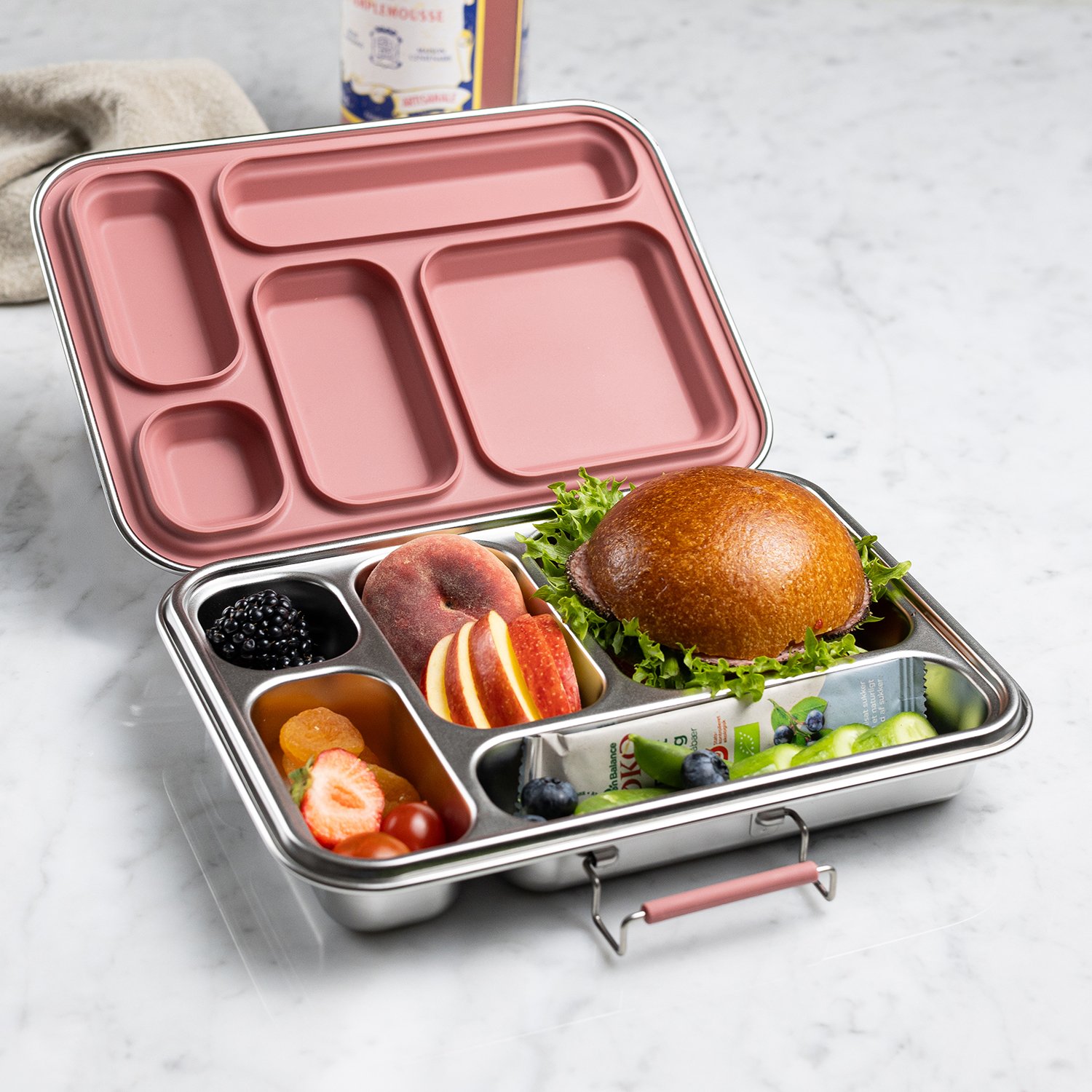
A lunch box with five compartments is ideal when your packed lunch consists of several different components that you want to keep separate. SteelMate's Bento lunch box has a total capacity of 935 ml, divided between five compartments of 340, 215, 182, 131 and 67 ml. The largest compartment is smaller than the largest compartment in the 3-compartment model, but in return, you get four smaller compartments to organise the rest of the meal.
This makes a 5-compartment lunch box suitable for a combination of a main meal, fruit, vegetables, berries and a small snack, for example. It is important to understand that five compartments do not provide more space than three. In fact, SteelMate's 5-compartment model has a slightly smaller total capacity than the 3-compartment model. The difference is that the available space is divided into more sections.
3 or 5 compartments – which should you choose?
Choose three compartments if a larger main meal takes up most of your packed lunch. Choose five compartments if variety and lots of small portions are more important. The difference can be seen directly in the size of the compartments:
| 3 compartments | 5 compartments | |
| Total capacity | 1,000 ml | 935 ml |
| Largest compartment | 500 ml | 340 ml |
| Smaller compartments | 2 | 4 |
| Best suited for | A larger main meal | Many small portions |
If your packed lunch mainly consists of large open sandwiches on rye bread or regular sandwiches, a main compartment of 500 ml will often be easier to work with.
If you frequently pack lots of different small items, on the other hand, five compartments can make your packed lunch easier to organise. It is not that one solution is better than the other. They simply meet different needs.
Fixed compartments or a removable divider?
The main differences between fixed compartments and a removable divider are flexibility and sealing. A removable divider can be adjusted from day to day. Fixed compartments remain the same size, but they can be combined with a lid that seals each compartment individually. SteelMate's 3- and 5-compartment lunch boxes have a moulded platinum-cure silicone insert in the lid. When the lid is closed, the silicone seals around the individual compartments, helping to keep the contents separate.
On models with a removable stainless steel divider, the lunch box itself is sealed against leaks on the outside, while the divider is primarily used to organise the contents. This gives you two different options:
- Removable divider: maximum flexibility.
- Fixed, sealed compartments: best when different foods need to be kept consistently separate.
Are all lunch boxes with compartments leakproof between sections?
No. A lunch box can be leakproof on the outside, preventing food or liquid from escaping into your bag, without being liquid-tight between the individual compartments.
This is an important distinction.
If the lid only seals around the outer edge of the lunch box, liquid can still move between the internal compartments. If each compartment is sealed individually against the lid, however, juice from fruit or salad dressing can be kept separate from bread and other dry foods.
You should therefore always check how the compartments are constructed if keeping food and liquids separate is important to you. Read our guide to leakproof lunch boxes, where we explain the difference in more detail.
Lunch boxes with compartments for children
Compartments can be practical for children because the entire packed lunch becomes visible and organised as soon as the lid is opened. However, the number of compartments should still be chosen according to the child's eating habits. A child who typically eats a larger main meal and a little fruit does not necessarily need five compartments. Conversely, several smaller compartments can work well for children who prefer a variety of small portions.
Ease of use, weight and size are also important factors. We have therefore covered these topics in our separate guide to lunch boxes for children.
Lunch boxes with compartments for adults and work
For adults, a removable divider is often a flexible solution because lunch can vary considerably from day to day. An everyday work lunch might consist of a sandwich one day, a salad the next and leftovers from dinner later in the week. In these situations, fixed compartments can sometimes restrict the available space unnecessarily.
A model of around 850 ml will suit many everyday work lunches, while a larger model of around 1,400 ml provides more room for larger portions or meal prep. Read more in our guide to lunch boxes for work.
Can you use snack boxes instead of several fixed compartments?
Yes. A lunch box with few or no fixed compartments can be combined with small snack boxes to create a more flexible layout. This can be particularly useful for dressing, dips, berries, nuts or a separate snack for later in the day. The advantage is that you only need to bring the smaller container on days when it is necessary.
SteelMate's snack boxes, including the 50 ml and 200 ml models, are designed to work alongside the larger lunch boxes. The 50 ml box, for example, fits inside the 5-compartment model, while both sizes can be placed inside the 3-compartment model. This provides an additional option between completely fixed compartments and one large, open lunch box.
Explore our range of snack boxes.
Which SteelMate lunch box with compartments should you choose?
The choice can broadly be narrowed down to three needs:
| If you want... | Choose |
| Maximum flexibility | 850 ml or 1,400 ml with a removable divider |
| A large main meal + two smaller items | 1,000 ml with 3 compartments |
| Many small, separate portions | 935 ml Bento with 5 compartments |
If you are still unsure about the overall size, read our guide to choosing the right lunch box size, where we compare capacity, dimensions and typical uses.
Frequently asked questions about lunch boxes with compartments
How many compartments are best in a lunch box?
There is no single optimal number. Two compartments offer great flexibility, three compartments work well for a main meal with side items, and five compartments are ideal for lots of smaller portions.
Are 3 or 5 compartments better for children?
Three compartments are typically best for larger sandwiches or a main meal, while five compartments are better for a varied packed lunch containing lots of small items.
Is the divider in a lunch box liquid-tight?
Not necessarily. A removable divider can keep solid foods separate without being liquid-tight. If liquid needs to be kept separate between compartments, the lunch box should have an individual seal around each compartment.
What is the difference between a bento lunch box and a regular lunch box with compartments?
Bento usually refers to lunch boxes with several fixed sections for different parts of a meal. A regular lunch box with compartments may also have just one removable divider.
Can adults use lunch boxes with compartments?
Yes. Lunch boxes with compartments can be used by both children and adults. For adults, a removable divider can be particularly practical because it provides space for different types of lunch.
Conclusion: Choose the number of compartments according to the food you actually pack.
The best lunch box with compartments is not necessarily the one with the most sections. If your packed lunch varies considerably from day to day, a removable divider offers the greatest flexibility. If you typically pack a larger main meal alongside fruit or snacks, three compartments are often a practical balance. If your packed lunch consists of lots of different smaller portions, five compartments provide more options for keeping everything organised and separate.
The most important thing is to choose a layout that suits the size and composition of your food, rather than choosing based on the number of compartments alone.