A good lunch box for starting school should be large enough for a full school day, easy for your child to open independently, and fit comfortably inside their school bag. The compartments should also suit the way your child's lunch is usually packed. For many schoolchildren, a lunch box of around 800–1,000 ml is a good starting point. However, capacity alone is not enough. Weight, the number of compartments, leakproof performance, and the lunch box's external dimensions also play an important role in everyday use.
Here is a simple guide to what you should look for when choosing a lunch box for starting school.
Which lunch box is best for starting school?
The best lunch box for starting school is one your child can handle independently and that has enough room for the food they need throughout the school day.
Choosing the right lunch box mainly depends on three things:
- Amount of food: Does your child only need lunch, or should the lunch box also accommodate a morning snack and other snacks?
- Types of food: Does the lunch consist of large open-faced rye bread sandwiches and regular sandwiches, or lots of small items?
- Your child's daily routine: Does the lunch box need to be carried over long distances, and how much other equipment is already in the school bag?
This means that the largest lunch box or the model with the most compartments is not necessarily the best choice.
How big should a school lunch box be?
A capacity of around 800–1,000 ml suits many schoolchildren, but your child's appetite and the length of the school day should determine the final choice.
As a practical starting point:
| Capacity | Typical use |
| 500–600 ml | A small packed lunch or a short school day |
| 800–900 ml | An everyday school lunch |
| 900–1,000 ml | A larger or more varied packed lunch |
| Over 1,000 ml | A larger appetite or several meals |
If your child has several breaks for eating throughout the day, a medium-sized lunch box combined with a separate snack box may be more practical than one very large lunch box.
Should you choose a school lunch box with 3 or 5 compartments?
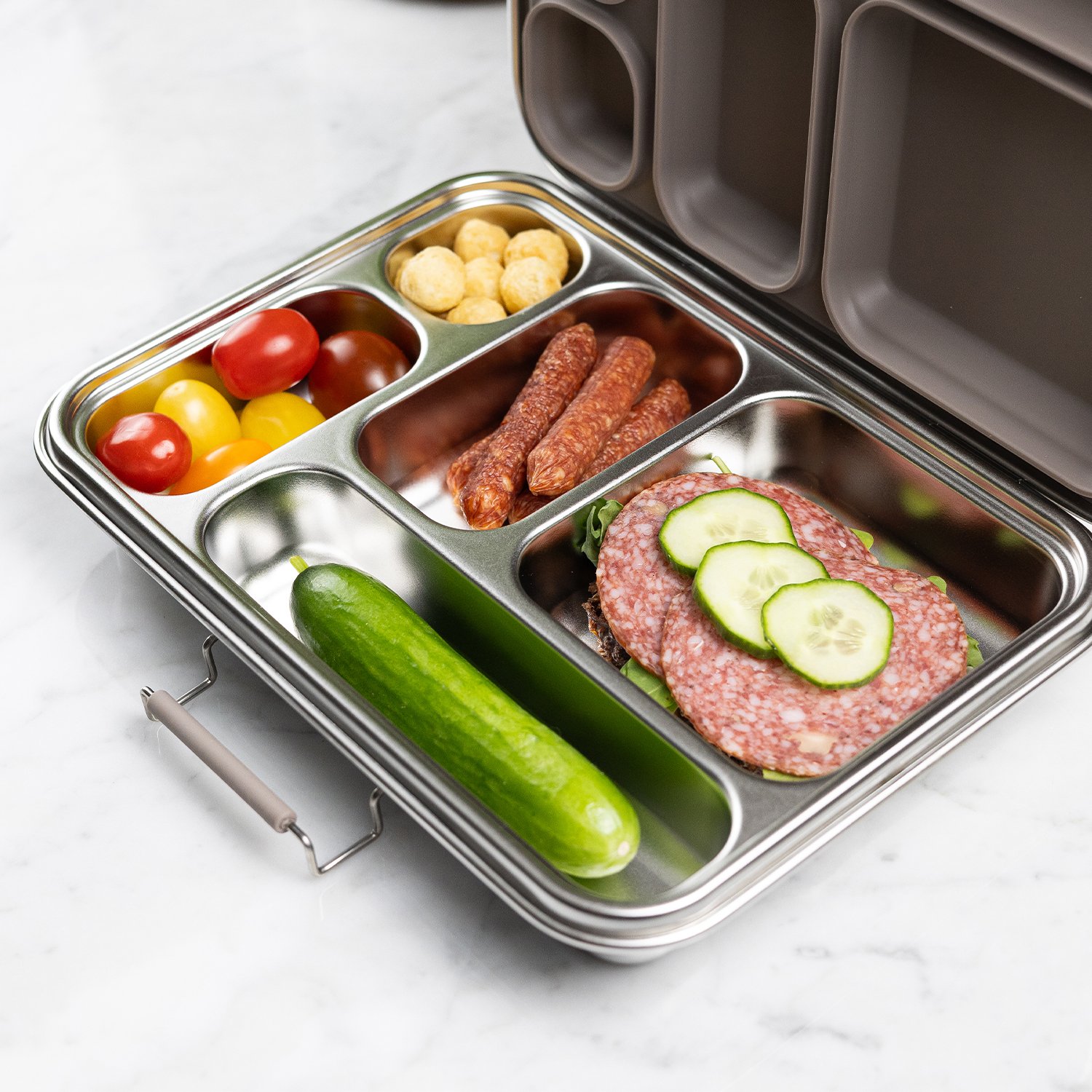
A lunch box with 3 compartments is best suited to a larger main meal with a couple of smaller items. A lunch box with 5 compartments works well for a packed lunch containing several different small items. For example, a 3-compartment lunch box can accommodate rye bread sandwiches or a regular sandwich in the largest compartment, with fruit and vegetables alongside.
A 5-compartment Bento lunch box distributes the available space more precisely and can be practical for children who prefer several smaller portions. SteelMate's 3-compartment lunch box has a capacity of 1,000 ml, while the 5-compartment Bento model holds 935 ml.
The difference is therefore not that five compartments provide more space. It is about how the available space is divided.
Read more in our guide to lunch boxes with compartments.
Should a lunch box be leakproof?
A leakproof lunch box is particularly practical in a school bag, where it is carried alongside books, electronic devices, and other belongings. However, there is a difference between preventing leaks from the lunch box into the bag and keeping food separate within the individual compartments. A lunch box may prevent liquid from escaping the container without necessarily preventing it from moving between compartments. If your child often brings juicy fruit, dressing, or other moist foods, fixed, sealed compartments can therefore be an advantage.
For drier foods, a lunch box with a removable divider may be a more flexible solution. Weight becomes particularly important when a child starts school, as the lunch box is just one of many items they need to carry. Books, a pencil case, a water bottle, a tablet or computer, and sportswear can all add to the weight of a school bag. You should therefore also consider the lunch box's empty weight.
For example, SteelMate's models range from approximately 170 grams for a small 550 ml stainless steel lunch box to around 670 grams for the 5-compartment Bento model. A heavier model may offer more features and a more advanced design, but its weight should be appropriate for your child and the way the lunch box will be carried.
Always check the lunch box's dimensions. Capacity tells you how much food the lunch box can hold, while its external dimensions determine whether it will fit inside the school bag. This is particularly important with Bento models, which are often relatively wide and flat. If your child already has their school bag, it is a good idea to compare the lunch box's dimensions with the compartment where it will be stored. In some bags, a compact 850 ml lunch box may be easier to fit than a wider model with a similar capacity.
Your child should be able to open the lunch box independently. A school lunch box only works well if your child can use it without assistance. Therefore, always try the opening and closing mechanism at home before the first day of school.
Your child should be able to open the lunch box, close it correctly, and check that the clips or locking mechanism are properly secured. This is particularly important with leakproof models, where the lid must be closed correctly to seal the lunch box.
Lunch box and snack box – a flexible solution
A separate snack box can be practical when starting school if your child has several breaks for eating. For example, a smaller box can be used for a morning snack, while the main lunch box is opened at lunchtime. This also makes it possible to use a simpler lunch box without needing five fixed compartments every day.
A snack box can also be used for smaller items such as fruit, nuts, vegetables, or dips that you want to keep separate from the rest of the packed lunch.
Which SteelMate lunch box is suitable for starting school?
SteelMate's models can generally be selected according to your child's needs:
| Need | Suitable model |
| A small, compact packed lunch | 550 ml |
| A flexible school lunch box | 850 ml with a removable divider |
| A larger main meal with side items | 1,000 ml with 3 compartments |
| Several different small items | 935 ml Bento with 5 compartments |
For many children, 850–1,000 ml is a good place to start. The choice between models should then depend on whether your child needs flexible space or fixed compartments.
Frequently asked questions about lunch boxes for starting school
How big should a lunch box be for a child starting their first year of school?
A capacity of around 800–1,000 ml will suit many children in their first year of school, but appetite and the length of the school day are more important than the school year alone.
Is a Bento lunch box good for school?
Yes, especially if your child brings several different small items. For large sandwiches or open-faced rye bread sandwiches, fewer and larger compartments may be more practical.
Do you need a separate snack box?
Not necessarily. However, a snack box can be useful if your child has several eating breaks or needs to keep certain foods separate.
Are stainless steel lunch boxes good for school?
Yes. Stainless steel is durable and suitable for repeated daily use. However, when choosing a lunch box for a child, you should also consider the specific model's weight and opening mechanism.
Conclusion:
When choosing a lunch box for starting school, you should first and foremost select one that suits your child's appetite, meals, and school bag. Around 800–1,000 ml is a good starting point for many schoolchildren. Choose 3 compartments if you need space for a larger main meal. Choose 5 compartments if your child prefers several smaller items. Alternatively, choose a more flexible model with one large compartment or a removable divider if the contents of the packed lunch vary considerably from day to day.
The best school lunch box is one your child can open independently, that fits inside their school bag, and that they will actually use every day.