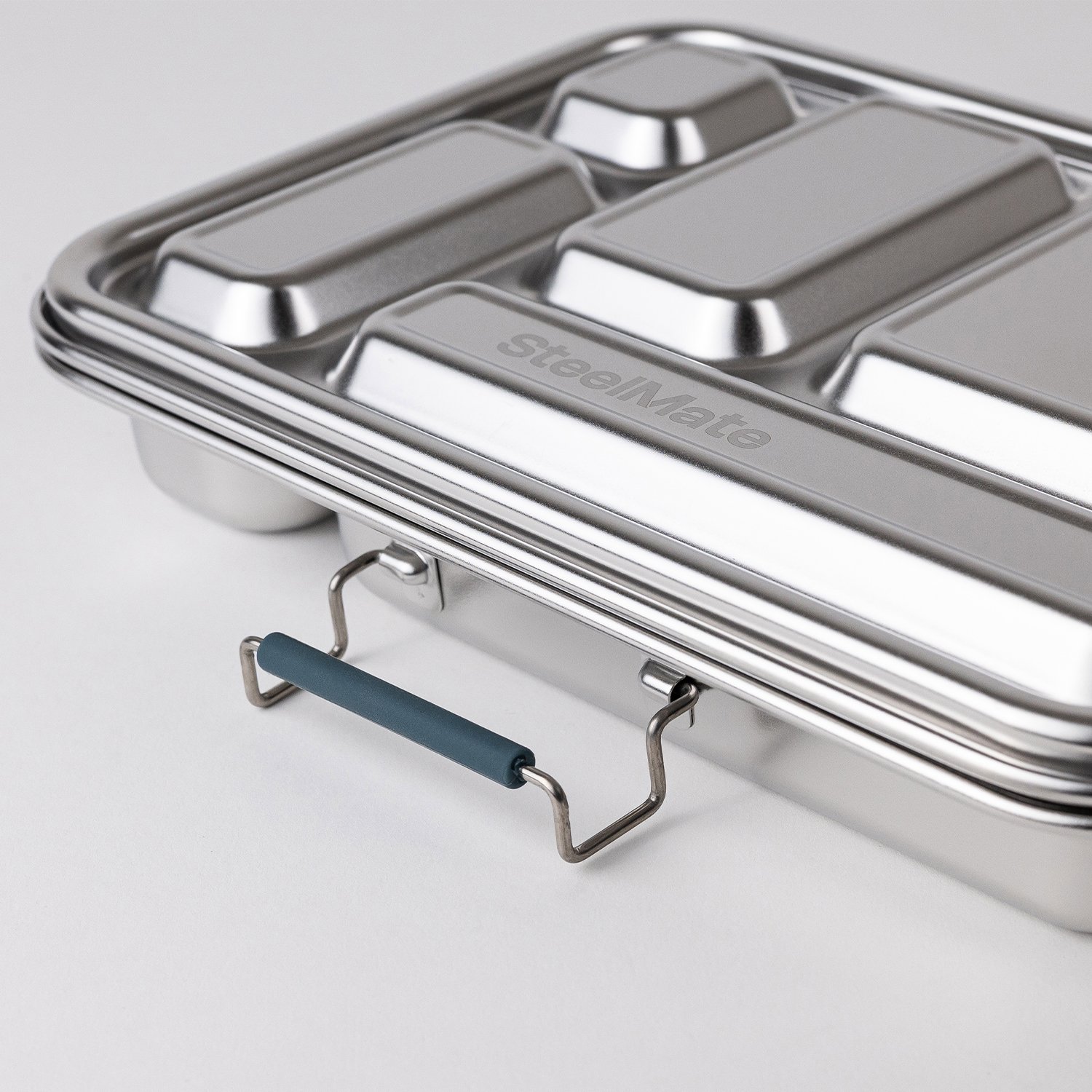
A stainless steel lunch box is a durable alternative to lunch boxes made from plastic or glass. Stainless steel is particularly well suited to lunch boxes because the material is hard-wearing, corrosion-resistant, and suitable for repeated contact with food when the finished product is designed for that purpose.
However, there are different types of stainless steel, and the construction of the lid, seals, and compartments is at least as important as the material itself. In this guide, we explain what you should know before choosing a stainless steel lunch box.
What is a stainless steel lunch box?
A stainless steel lunch box is a container made primarily from stainless steel. Stainless steel is an alloy based on iron and chromium and, depending on the grade, may also contain other alloying elements such as nickel. The high chromium content gives stainless steel its characteristic resistance to corrosion.
The Danish Veterinary and Food Administration describes stainless steel as a common material used for items such as cutlery, pots, equipment, and packaging intended for food contact. Like other food contact materials, the finished product must be suitable for its intended use.
What do 304 and 18/8 stainless steel mean?
304 stainless steel is often called 18/8 stainless steel because the alloy typically contains approximately 18% chromium and 8% nickel.
304 is one of the most widely used grades of stainless steel for kitchen and food-related equipment.
SteelMate's lunch boxes are made from 304 (18/8) stainless steel.
When comparing stainless steel lunch boxes, the designations 304 and 18/8 therefore provide useful information about the material. However, the grade of steel does not tell you everything about the finished lunch box.
You should also consider:
- The construction of the lid
- Any seals or gaskets
- Leakproof performance
- Compartment layout
- Documentation confirming suitability for food contact
What are the advantages of a stainless steel lunch box?
The main advantage of stainless steel is its combination of durability, corrosion resistance, and a robust surface suitable for everyday use. Stainless steel lunch boxes can therefore be suitable for school, work, picnics, and other situations where the lunch box is transported and used repeatedly.
Stainless steel also has a smooth surface that is easy to clean, and the material can withstand considerable mechanical stress. However, this does not mean the surface will remain cosmetically perfect. A stainless steel lunch box may develop scratches, small marks, and a patina over time without this necessarily affecting its functionality.
Can a stainless steel lunch box rust?
Stainless steel is corrosion-resistant, but it is not completely immune to rust or discolouration. The term "stainless" can therefore be slightly misleading. The chromium content forms a very thin protective layer on the surface, making the material significantly more resistant to corrosion than ordinary steel. However, the surface can still be affected under certain conditions.
Discolouration on stainless steel does not automatically mean that the steel itself has corroded. Surface deposits and so-called flash rust, for example, can result from particles of other metals. Proper cleaning and drying after use are therefore important parts of maintaining the product.
We explore this in more detail in our guide to cleaning and maintaining stainless steel lunch boxes.
Are stainless steel lunch boxes heavy?
This depends more on the construction and size than on the material alone. A simple stainless steel lunch box can be relatively lightweight, while a model with several fixed compartments, a sturdy lid, clips, and silicone seals will weigh more.
SteelMate's models illustrate the differences:
| Model | Capacity | Weight |
| Small stainless steel lunch box | 550 ml | 170 g |
| Stainless steel lunch box with divider | 850 ml | 260 g |
| Large stainless steel lunch box with divider | 1,400 ml | 370 g |
| Lunch box with 3 fixed compartments | 1,000 ml | 500 g |
| Bento lunch box with 5 compartments | 935 ml | 670 g |
Weight should therefore always be considered alongside functionality. A lunch box with several sealed compartments will typically have a more complex construction and consequently weigh more than a simple stainless steel container.
Can a stainless steel lunch box be leakproof?
Yes, but the steel itself is not what makes the lunch box leakproof. Leakproof performance is typically achieved with a flexible gasket between the lid and the container. For example, SteelMate's lunch boxes with removable dividers have a stainless steel lid combined with a silicone gasket and metal clips that press the lid against the container.
The construction may be different for lunch boxes with several fixed compartments, because each individual compartment may also need to remain separate. If leakproof performance is important to you, you should therefore ask not only:
"Is the lunch box made from stainless steel?" but also: "How are the lid and seal designed?"
Can a stainless steel lunch box go in the microwave?
No. A stainless steel lunch box must not be used in a conventional microwave oven. If the food needs to be heated in a microwave, it must first be transferred to a suitable plate or container. This is one of the main practical differences between a stainless steel lunch box and certain types of plastic or glass containers.
However, a lunch box is primarily designed to transport and store food, and stainless steel is a practical material for this purpose when used repeatedly in everyday life.
Stainless steel lunch boxes with or without compartments?
The choice depends on the food you normally bring with you. A lunch box with one large compartment provides maximum space for sandwiches, open sandwiches on rye bread, salads, and larger dishes. A removable divider allows you to change the layout from day to day.
Fixed compartments, such as models with 3 or 5 sections, are better if different parts of your packed lunch need to be kept separate consistently. If compartment layout is the most important factor in your decision, read our complete guide to lunch boxes with compartments.
Are stainless steel lunch boxes best for children or adults?
Stainless steel lunch boxes can be used by both children and adults. The relevant factors are size and construction. For children, you should pay particular attention to weight, external dimensions, and whether the child can open the lunch box independently. For adults, capacity and flexibility will often be more important. A model of around 850 ml suits many everyday lunches, while approximately 1,400 ml provides more space for larger meals and meal prep.
The material does not necessarily need to change; the needs do.
Frequently asked questions about stainless steel lunch boxes
What does 18/8 stainless steel mean?
18/8 means that the steel typically contains approximately 18% chromium and 8% nickel. The designation is commonly used for 304 stainless steel.
Is 304 stainless steel suitable for food?
304 stainless steel is widely used for food-related products and kitchen equipment. It is also essential that the finished product is manufactured and documented as suitable for its intended food contact.
Can stainless steel get scratched?
Yes. Scratches and other cosmetic signs of wear can develop during normal everyday use and do not necessarily mean that the lunch box has lost its functionality.
Can stainless steel rust?
Stainless steel has a high level of corrosion resistance, but it is not completely immune to corrosion or surface damage.
Are stainless steel lunch boxes dishwasher-safe?
This depends on the specific model, particularly its lid, seals, and other components. Always follow the manufacturer's cleaning instructions.
Conclusion
A stainless steel lunch box is a good choice if you want a durable, reusable lunch box for everyday use. 304 (18/8) stainless steel is a widely used grade for products intended for contact with food, and it is the grade SteelMate uses in its stainless steel lunch boxes. However, when choosing a model, you should consider more than just the material. Size, weight, compartment layout, and lid construction are equally important in determining whether the lunch box will work well in your everyday life.