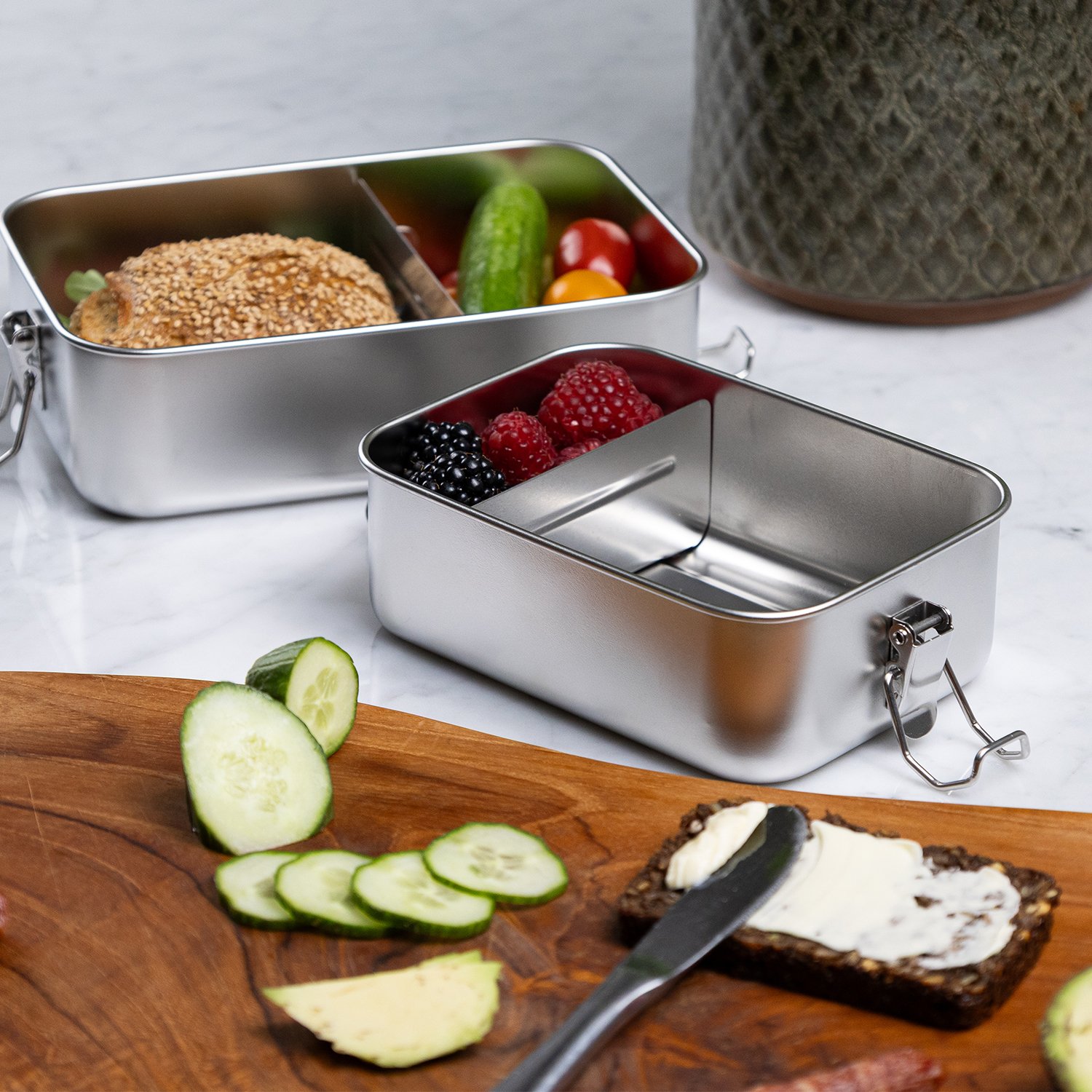
Should your next lunch box be made from stainless steel or plastic? Both materials can work well for packed lunches, but they have different properties that affect weight, durability, cleaning, and how the lunch box is used.
A stainless steel lunch box is generally a good choice if you prioritise a durable, shape-retaining material that can be used again and again. A plastic lunch box, on the other hand, can be lighter and is available in many different shapes and designs.
Here, we explore the most important differences to help you choose the solution that best suits your everyday needs.
In brief: stainless steel or plastic?
The choice depends primarily on what matters most to you.
- Stainless steel: durable, shape-retaining, easy to clean, and generally does not absorb flavours or odours from food.
- Plastic: often lighter, highly versatile in terms of shape and design, and available in many styles and price ranges.
For a lunch box that will be used frequently and carried back and forth between home, school, or work, many people choose stainless steel because of its strength and long-term usability.
Why choose a stainless steel lunch box?
Stainless steel is a strong material that is well suited to products designed to withstand everyday use. A stainless steel lunch box retains its shape and can generally withstand considerably more mechanical stress than many thin plastic containers.
This does not mean that a stainless steel lunch box cannot get scratched or dented. On the contrary, a product that is used frequently will often develop visible signs of wear over time. However, these marks do not necessarily affect the lunch box's functionality.
For many people, these signs of everyday use simply become part of a product that accompanies them through countless meals and days.
Does stainless steel absorb flavours or odours?
One of the advantages of stainless steel is its smooth, non-porous surface. The material generally does not absorb odours, colours, or flavours from food in the same way that some other materials can over time.
This is practical if you use the same lunch box for different types of meals. For example, you can bring pasta salad one day and sandwiches, fruit, or vegetables the next.
Thorough cleaning is still important, of course, particularly around the lid, seals, and other areas where food residue can accumulate.
Is a plastic lunch box a bad choice?
No. Plastic is a broad term covering many different materials and grades, and a lunch box made from a material suitable for food contact can be a perfectly functional solution.
Plastic has the particular advantage of being lightweight and easy to mould into different shapes. This makes it possible to manufacture lunch boxes with complex compartment layouts, hinges, and closing mechanisms without significantly increasing their weight.
For children who need to carry a very light school bag, weight can therefore be an important consideration.
The most important factor is not simply whether the material is called plastic or stainless steel, but whether the product is intended for food contact and is used in accordance with the manufacturer's instructions.
Which lunch box lasts the longest?
Service life depends on the material, the construction, and how the product is used.
Stainless steel generally has high mechanical strength, making it suitable for a lunch box that travels back and forth every day. The steel body itself also does not contain hinges or flexible areas that need to bend every time the lunch box is opened.
In both stainless steel and plastic lunch boxes, lids, seals, clips, and other moving or flexible components are often the parts that wear out first.
The availability of replacement parts can therefore be just as important as the material used for the container itself. If a seal can be replaced, there may be no need to discard an otherwise fully functional lunch box.
How heavy is a stainless steel lunch box compared with a plastic one?
A plastic lunch box will often be lighter than a comparable model made from stainless steel. However, the size of the difference depends on the dimensions, material thickness, lid, and overall construction.
For adults and older children, the difference may not matter much, while weight can be more relevant for younger children who already have books, a water bottle, and other equipment in their bags.
If low weight is your most important criterion, compare the actual product weights rather than looking at the material alone.
Which material is easiest to clean?
Both stainless steel and plastic can be easy to clean when the lunch box has a simple design.
Stainless steel has a smooth surface and generally withstands repeated cleaning well. A design with few joints and corners also makes it easier to reach every area.
For a leakproof lunch box, pay particular attention to the silicone seal. Food residue and moisture can accumulate around the seal, so it should be cleaned regularly in accordance with the manufacturer's instructions.
Always follow the cleaning instructions for the specific lunch box, as the lid, seals, and other components may have different requirements from the container itself.
Can a stainless steel lunch box go in the microwave?
No. Stainless steel lunch boxes and other stainless steel containers should not be used in a conventional microwave oven.
If you often bring food that needs to be heated in the microwave at work or school, you will need to transfer it to a suitable plate or container before heating it.
This is a practical difference between stainless steel and certain types of plastic, as some plastic products are specifically approved for microwave use.
Always check the manufacturer's instructions before heating food in a plastic container, as not all types of plastic or lunch boxes are designed to withstand high temperatures.
Are stainless steel lunch boxes leakproof?
Stainless steel does not automatically make a lunch box leakproof. This primarily depends on the lid, seal, and closing mechanism.
A leakproof lunch box made from stainless steel typically has a silicone seal that presses against the rim when the lid is closed. Clips or another closing mechanism then keep the lid securely in place during transport.
The same principle can be used in plastic lunch boxes. You should therefore always look at the specific design rather than assuming that a particular material automatically makes a lunch box leakproof.
Stainless steel lunch boxes with or without compartments?
Once you have chosen the material, the next question is often how the lunch box should be organised.
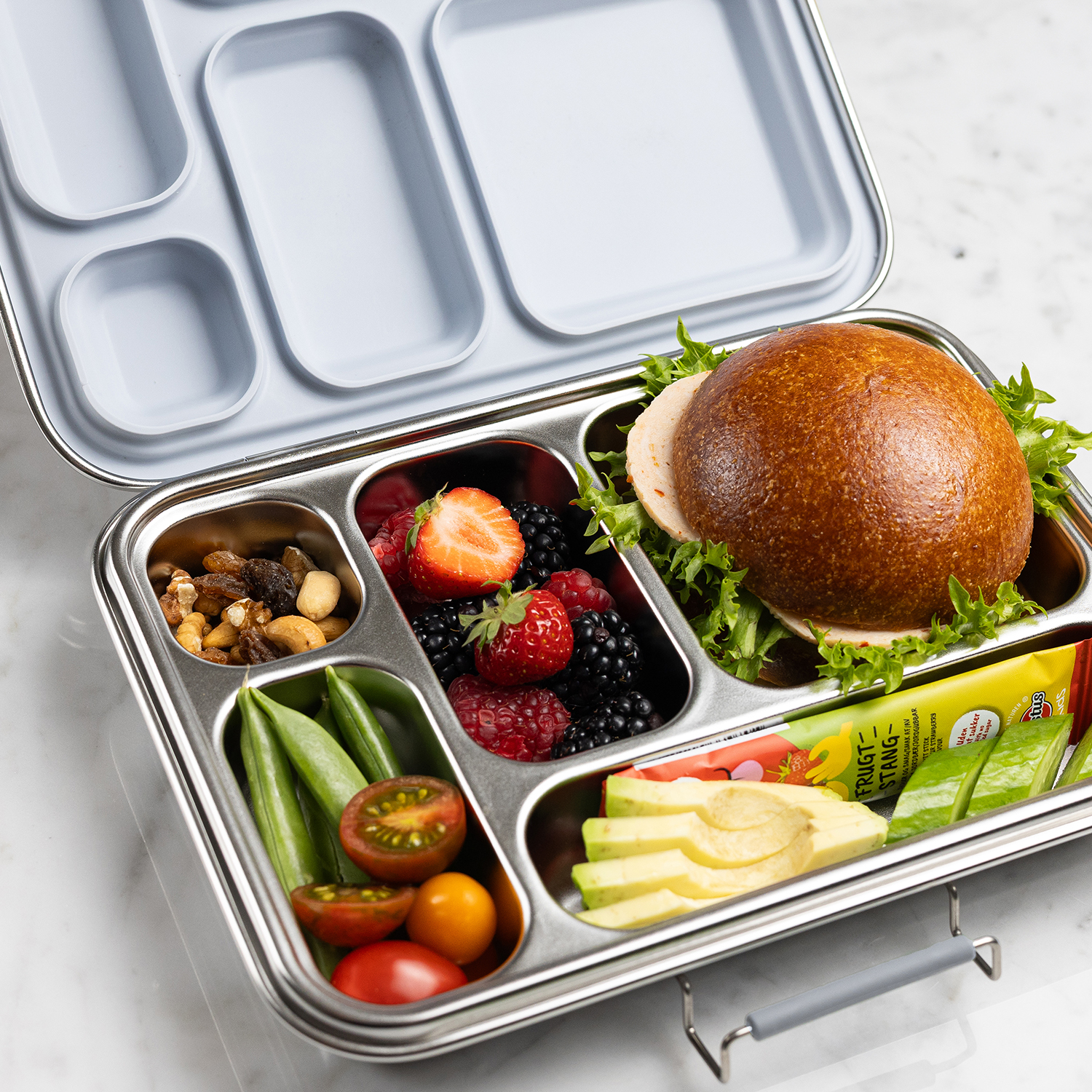
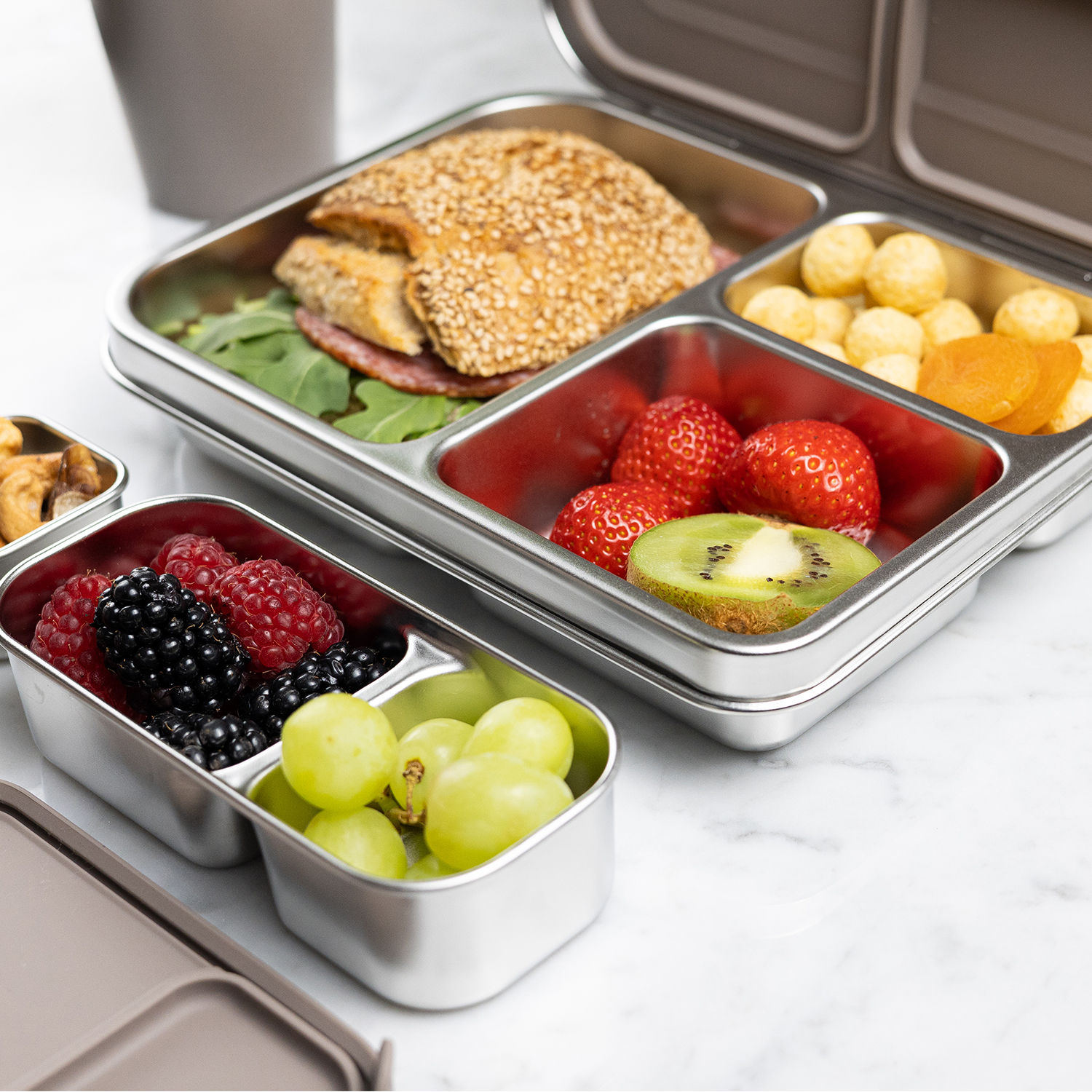
A lunch box with compartments is practical if you want to keep sandwiches, vegetables, fruit, and snacks separate.
A lunch box without compartments provides one large space, giving you more freedom to pack larger sandwiches, salads, leftovers, and other meals that do not fit neatly into fixed sections.
There are also lunch boxes with removable dividers. They combine the advantages of both solutions because the layout can be adjusted to suit the food you are packing that day.
Stainless steel lunch boxes for children
For children, durability is only part of the equation. The lunch box must also suit the child's appetite and school bag and be easy for them to open independently.
A large stainless steel lunch box may be unnecessarily heavy for a younger child who only needs a small lunch. On the other hand, a suitably sized model can be practical because its robust construction stands up well to everyday life in a school bag.
Consider the following factors:
- The lunch box's size and weight
- How easily the child can open and close it
- Whether compartments are needed
- Whether the lid needs to be leakproof
- How much food the child normally eats
Stainless steel lunch boxes for work
For work, your needs may be slightly different. You might need room for a larger lunch, salad, leftovers from dinner, or several snacks for a long day.
A stainless steel lunch box is well suited to this type of use because it can hold many different types of food without absorbing flavours or odours from previous meals.
However, if you bring hot food, remember the difference between a regular lunch box and an insulated food container. A standard stainless steel lunch box will not automatically keep food warm.
Which is better – stainless steel or plastic?
There is no single material that is best for everyone.
Stainless steel is particularly worth considering if you prioritise:
- A durable material that retains its shape
- A surface that generally does not absorb flavours or odours
- A straightforward product for repeated everyday use
- A material that can retain its functionality over a long period
Plastic may be more suitable if very low weight, a particular shape, or the ability to heat food in a microwave is more important to you.
In practice, the best lunch box is the one that suits the person using it, the food it holds, and the everyday routine it needs to fit into.
Stainless steel lunch boxes from SteelMate
At SteelMate, we have chosen stainless steel as the core material for our lunch boxes because it reflects the way we want to develop our products: durable materials, straightforward functionality, and products designed to be used again and again.
Our range includes different sizes and solutions with open compartments, fixed divisions, and flexible dividers, allowing you to choose a lunch box based on how you will actually use it.
Ready to find your next SteelMate?
SteelMate is a Danish brand focused on thoughtfully designed products for everyday life. We develop functional products for children, adults, and families, with an emphasis on durable quality, good materials, and simple design. Our products are made to be used again and again.
We have a particular appreciation for stainless steel, but always choose materials based on the function of each product. Whether you are looking for something for your packed lunch, work, school, kitchen, or life on the go, our aim is to make it easy to find products that work in practice.
If you have questions about sizes, materials, features, cleaning, or which product best suits your needs, you are always welcome to contact us. We are happy to share our experience and help you find the right solution.
You can explore our full range of lunch boxes here. We ship from Denmark with delivery in 1–2 business days, and you get free shipping to a parcel shop on orders over 499 DKK.
SteelMate – products made to be used, and made to be your mate in everyday life.