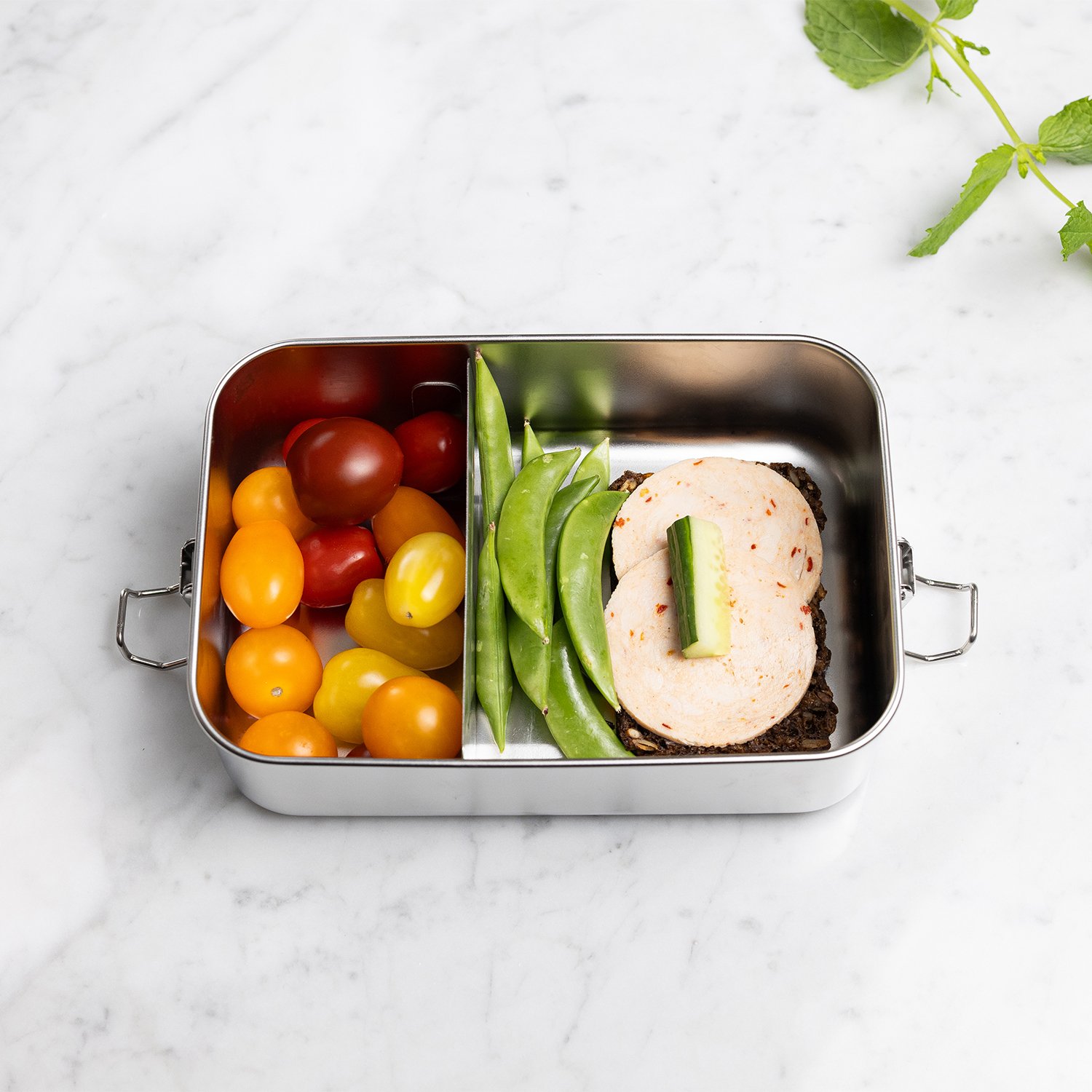
The right lunch box size depends on how much food you need to bring, the type of food you pack, and whether the space is divided into several compartments. As a practical starting point, a lunch box with a capacity of 500–600 ml is suitable for snacks or a small lunch, 800–1,000 ml for an everyday packed lunch, and 1,200–1,400 ml for larger meals, long days, or meal prep.
However, capacity does not tell the whole story. A 1,000 ml lunch box with three fixed compartments can work very differently from an 850 ml lunch box with one large compartment. You should therefore always consider capacity, shape, compartment layout, and external dimensions.
Lunch box sizes – a quick overview
Most everyday lunch box needs can be divided into the following categories:
| Capacity | Typically suitable for |
| 400–600 ml | Snacks, a small meal, or a light lunch |
| 700–900 ml | An everyday packed lunch |
| 900–1,000 ml | A larger packed lunch or one divided into compartments |
| 1,200–1,400 ml | A large lunch, long days, and meal prep |
| Over 1,400 ml | Multiple meals or very large portions |
(These figures are guidelines.)
Two people with the same appetite may need different sizes if one brings a compact pasta dish while the other packs open sandwiches on rye bread, fruit, and several separate snacks. The most important thing is therefore to choose a lunch box based on the food it will actually need to hold.
Is 550 ml large enough for a lunch box?
A lunch box with a capacity of around 550 ml is a small, compact option that is particularly suitable for snacks, a small meal, or a light lunch.
It may be suitable for a couple of open sandwiches on rye bread, a small sandwich, fruit, snacks, or a small portion of leftovers. SteelMate's 550 ml model measures 16 × 10.4 × 6 cm and weighs 170 grams. It has one large, uninterrupted compartment, meaning the entire capacity can be used without fixed dividers.
It is worth noting that 550 ml can feel more spacious in a lunch box with one large compartment than in a model with several small compartments, because no space is taken up by dividers and separate sections. However, for a large work lunch or a long school day, 550 ml will often be on the small side.
Is 850 ml a good size for a packed lunch?
An 850 ml lunch box is a versatile medium-sized option that suits many everyday lunches for both older children and adults. SteelMate's 850 ml lunch box measures 17.8 × 12.2 × 6.3 cm and weighs 260 grams. It has a removable divider, allowing the space to be used as one large compartment or divided into two sections.
This makes the size flexible. On one day, you can use the entire lunch box for a large sandwich, salad, or pasta dish. On another day, you can use the divider to keep the main meal separate from vegetables, for example. If you are unsure which size to start with for an everyday lunch, around 800–900 ml is a good starting point.
Is 1,000 ml a large lunch box?
A 1,000 ml lunch box, equivalent to one litre, is at the spacious end of the range for everyday packed lunches, but it is not necessarily physically very large. The compartment layout makes a significant difference. For example, SteelMate's 3-compartment lunch box has a total capacity of 1,000 ml, divided into three compartments of 500, 300, and 200 ml. It measures 23.5 × 18 × 4.7 cm.
This makes it lower and wider than SteelMate's 850 ml model. A capacity of 1,000 ml therefore does not necessarily mean a tall or bulky lunch box. The volume can be distributed across a larger surface area.
A lunch box with a capacity of around one litre is particularly suitable for:
- Nursery and school lunches with several different items
- Larger lunches
- Packed lunches with fixed compartments
- People who want to pack both a main meal and snacks together
How big is a Bento lunch box?
Bento lunch boxes often have several fixed compartments, so their size should not be assessed by capacity alone. For example, SteelMate's Bento model has a capacity of 935 ml, divided into five compartments of 340, 215, 182, 131, and 67 ml. It measures 25.5 × 18.5 × 5 cm. Its total capacity is therefore slightly smaller than that of SteelMate's 1,000 ml 3-compartment model, but the Bento model has a more divided layout.
This makes it suitable for lots of smaller items, while its main compartment is not as large. A Bento lunch box with a capacity of around 900–1,000 ml is therefore not necessarily the best choice for a large sandwich or wrap, even if its total capacity looks generous. The size of the largest compartment is at least as important as the overall capacity.
When should you choose a 1,400 ml lunch box?
A 1,400 ml lunch box is a large option that is particularly suitable for generous portions, long working days, picnics, or meal prep. The extra capacity allows you to bring more than an everyday lunch or pack dishes that take up more space.
Like the 850 ml model, SteelMate's 1,400 ml model has a removable divider. It can therefore be used as one large compartment or divided as needed. A large lunch box is particularly useful if you often find that a regular lunch box is completely full.
However, bigger is not automatically better. If you normally bring only a small lunch, a 1,400 ml lunch box will take up more space in your bag without necessarily offering any practical advantage.
What size lunch box should children have?
For many children, a lunch box with a capacity of around 800–1,000 ml is a good starting point, but the child's appetite and the length of the day matter more than age alone. A child who only needs to bring one small meal may need less space.
A child who needs to bring a morning snack, lunch, and additional snacks from home may need more room. The compartment layout also affects the required size. If the packed lunch consists of one larger main meal, a large, uninterrupted compartment may be the most useful. If the child brings lots of different small items, a Bento or 3-compartment model with a capacity of around 900–1,000 ml may work better.
Read more in our guide to lunch boxes for children, where we also cover weight, opening mechanisms, and the differences between nursery and school.
What size lunch box should you choose for work?
For an everyday work lunch, around 800–1,000 ml will suit many adults. If you bring a sandwich, open sandwiches on rye bread, salad, or an ordinary portion of leftovers, an 850 ml lunch box is typically a good starting point.
If you have a larger appetite, work long days, bring several meals, or use your lunch box for meal prep, a capacity of around 1,400 ml may be more practical. The right size also depends on whether you use separate snack boxes. In practice, someone with an 850 ml main lunch box and a small snack box may have just as much flexibility as someone with one very large lunch box.
How do compartments affect the size of a lunch box?
Fixed compartments make a lunch box more organised, but they reduce the flexibility of how its capacity can be used. It is therefore important to distinguish between total capacity and the usable space available for a particular type of food.
A 935 ml lunch box with five compartments may be perfect for fruit, vegetables, small sandwiches, and snacks. However, an 850 ml lunch box with one large compartment may be better for a large sandwich, even though its total capacity is smaller.
This means you should not always choose the lunch box with the highest capacity in millilitres. If you often pack large food items, uninterrupted space is important. If you frequently pack lots of small items, how the space is divided matters more.
Should you choose a lunch box based on capacity or dimensions?
You should consider both. Millilitres tell you how much the lunch box can hold. Its external dimensions tell you how much space it takes up in your bag.
SteelMate's models illustrate the difference:
| Model | Capacity | Dimensions |
| Small stainless steel lunch box | 550 ml | 16 × 10.4 × 6 cm |
| Stainless steel lunch box with divider | 850 ml | 17.8 × 12.2 × 6.3 cm |
| 3-compartment lunch box | 1,000 ml | 23.5 × 18 × 4.7 cm |
| Bento with 5 compartments | 935 ml | 25.5 × 18.5 × 5 cm |
A Bento lunch box can therefore be wider than a larger lunch box with one or two compartments because its volume is distributed across a flatter surface. This is particularly important for school and work bags, where the shape can matter just as much as the capacity.
How much extra space should a lunch box have?
A lunch box does not need to be completely full to be the right size. A little extra space makes it easier to vary your packed lunch from day to day. However, if the lunch box is consistently only half full, it is probably larger than necessary.
A good approach is to choose a size that comfortably accommodates your usual packed lunch while leaving a little room for variation. You should not choose based on the largest lunch you might bring a few times a year. Choose based on your everyday needs.
Which size SteelMate lunch box should I choose?
As a simple starting point, SteelMate's sizes can be compared as follows:
| Need | Capacity |
| Snacks or a small meal | 550 ml |
| Everyday lunch | 850 ml |
| Varied packed lunch with 5 compartments | 935 ml |
| Packed lunch with 3 larger compartments | 1,000 ml |
| Large lunch or meal prep | 1,400 ml |
The choice between 935 and 1,000 ml should primarily be based on the compartment layout. The choice between 850 and 1,400 ml depends more on the amount of food you need. If 550 ml is enough, you will also get a more compact lunch box that takes up less space in your bag.
Frequently asked questions about lunch box sizes
Is 500 ml enough for lunch?
For a small lunch, around 500–600 ml may be sufficient. For an ordinary adult lunch or a longer school day, many people will benefit from having more space.
Is 850 ml enough for an adult?
Yes. Around 850 ml will suit many everyday lunches for adults. For large portions or multiple meals, 1,200–1,400 ml may be more suitable.
Is one litre a large lunch box?
One litre is a spacious but still standard lunch box size. How large it feels depends considerably on its shape and compartment layout.
What size lunch box is suitable for school?
A capacity of around 800–1,000 ml will suit many schoolchildren, but appetite, the length of the day, and the number of meals should determine the choice.
Is a larger lunch box always better?
No. An unnecessarily large lunch box takes up more space and may weigh more. The best size is one that suits your usual amount of food while allowing a little extra flexibility.
Conclusion: choose a size based on the amount of food and the compartment layout. If you want to choose a lunch box size quickly, use this rule of thumb:
- 550 ml for snacks and small meals.
- 850 ml for an everyday lunch.
- 900–1,000 ml for a larger or more divided packed lunch.
- 1,400 ml for large portions, long days, and meal prep.
However, capacity in millilitres should never be the only consideration.
Also consider how much uninterrupted space you need, how the compartments are arranged, and whether the lunch box's external dimensions fit your bag. The right size is not the largest lunch box you can find.
It is the smallest size that comfortably accommodates the food you normally bring.